The GST Set-Off Order
Why you can pay GST in cash while sitting on unused input tax credit.
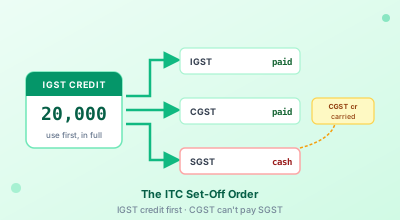
Here is a result that surprises people every month. Your books show ₹30,000 of GST credit and ₹30,000 of GST liability. The two numbers match. And yet the portal still asks you to pay ₹5,000 in cash. Nothing is wrong with your accounting. The credit is real and the liability is real. What trips you up is the order in which the law makes you spend that credit, and a rule that stops one kind of credit from paying another kind of tax.
That order is not a matter of preference. It is fixed by Section 49, Section 49A, and Rule 88A of the GST law, and the portal applies it for you automatically in GSTR-3B. You cannot override it. But understanding it is the difference between knowing why your cash outgo is what it is and staring at a challan that seems to come from nowhere. This post walks through the order the way it actually plays out on a return, with the one worked example that makes the whole thing click.
The Two Rules That Explain Everything
Strip away the section numbers and there are only two things to remember.
Rule one: IGST credit goes first, and all of it. Before you are allowed to spend a single rupee of CGST or SGST credit, your IGST credit has to be fully used up. It pays IGST liability first, and whatever is left over can go against CGST and SGST liability in any order you like. This is Section 49A, softened by Rule 88A. The "any order" part is the only choice the law gives you in the whole exercise, and it matters more than it looks — we will come back to it.
Rule two: CGST and SGST credit stay in their lanes. CGST credit can pay CGST, and if any IGST liability is still open, it can pay that too. It cannot pay SGST. Ever. SGST credit is the mirror image: it pays SGST, then leftover IGST, and never CGST. This is the cross-utilisation bar in Section 49(5), and it is the reason credit gets stranded. The Centre's half of your tax and the State's half of your tax are, for credit purposes, two separate pots that are not allowed to leak into each other.
Everything else is bookkeeping. Once IGST credit is exhausted against everything it can reach, and CGST and SGST credit have each covered as much of their own head as they can, whatever liability is left has to be paid in cash through the electronic cash ledger. Any credit that had nowhere legal to go stays in the electronic credit ledger and carries forward to next month.
The Utilisation Table
Here is the whole order on one screen. This is exactly what the portal does inside GSTR-3B, and what the set-off calculator applies.
| Credit held | 1st: pay this | 2nd: then this | Cannot pay |
|---|---|---|---|
| IGST credit | IGST | CGST & SGST (any order) | — |
| CGST credit | CGST | IGST | SGST / UTGST |
| SGST / UTGST credit | SGST / UTGST | IGST | CGST |
Read the last column carefully, because that is where the cash comes from. IGST credit has no restriction — it is the universal currency of the credit ledger. CGST and SGST credit each carry one hard prohibition, and those two prohibitions are what force a cash payment even when your total credit equals your total liability.
The Worked Example That Makes It Click
Take a small trader whose GSTR-3B for the month works out to this. Output liability: IGST ₹10,000, CGST ₹10,000, SGST ₹10,000 — ₹30,000 in all. Credit available: IGST ₹20,000, CGST ₹5,000, SGST ₹5,000 — also ₹30,000. Balanced on paper. Watch what the order does to it.
Step one — spend the IGST credit (₹20,000), and it must all go before anything else moves. ₹10,000 clears the IGST liability. That leaves ₹10,000 of IGST credit still to place. The tool applies it to CGST next, and it exactly clears the ₹10,000 CGST liability. IGST credit is now fully used. So far, so good: IGST and CGST liabilities are both at zero, and we have not touched a rupee of cash.
Step two — the CGST credit (₹5,000). But CGST liability is already nil, cleared by the IGST credit a moment ago. CGST credit's only other destination is IGST liability, and that is nil too. It has nowhere to go. It cannot cross over to help with SGST — that is the bar. So the full ₹5,000 of CGST credit sits idle and carries forward.
Step three — the SGST credit (₹5,000). SGST liability is still the full ₹10,000; nothing has touched it yet. The ₹5,000 of SGST credit pays half of it. The other ₹5,000 has no credit left to cover it.
Final position: ₹5,000 of SGST paid in cash, and ₹5,000 of CGST credit carried forward. The business had ₹30,000 of credit against ₹30,000 of liability and still wrote a ₹5,000 cheque — because ₹5,000 of that credit was the wrong kind of tax to pay the liability that was left. Punch the same numbers into the set-off calculator and you will see this outcome fall out line by line.
Work Out Your Own Net Cash Payable
Enter your CGST, SGST, and IGST liability and available credit. The tool applies the exact legal order and shows your cash payable per head plus any credit carried forward.
Open the Set-Off CalculatorWhy This Happens in Real Businesses
The stranded-credit outcome is not a rare edge case. It follows directly from a mismatch between where you buy and where you sell.
A shop that buys most of its stock from out-of-state wholesalers accumulates IGST credit, because inter-state purchases carry IGST. If that shop sells mostly to local customers, its output is CGST plus SGST. The IGST credit is flexible and mops up a good chunk of both, but the arithmetic rarely lands clean, and one of the two local heads tends to be left owing cash. The reverse — buying locally, selling inter-state — piles up CGST and SGST credit against an IGST-heavy output, and there the local credit can at least flow up into IGST liability, so it strands less often.
Exporters and anyone selling zero-rated feel this hardest. Their output liability is little or nothing, so purchase credit has almost nothing to set off against and simply accumulates. That is a different problem with a different fix — a refund claim rather than a carry-forward — but it comes from the same head-restriction machinery.
The important thing to internalise: carried-forward credit is not lost money. It sits in your electronic credit ledger and is fully available next month against next month's liability. It is a timing cost, not a real one — you have parted with cash sooner than the credit could absorb it. For a thin-margin business, though, timing costs are real enough to plan around.
The One Lever You Actually Control
Almost all of the set-off is mechanical and the portal does it for you. There is exactly one decision left in your hands, and it is the "any order" clause in Rule 88A: once IGST liability is covered, you choose how to split the remaining IGST credit between CGST and SGST.
Split it badly and you can strand credit that a better split would have used. Suppose after paying IGST you have ₹10,000 of IGST credit left, a CGST liability of ₹4,000, an SGST liability of ₹8,000, and you also hold ₹6,000 of CGST credit but no SGST credit. Dump all the IGST credit onto CGST and you clear the ₹4,000 CGST but leave ₹6,000 of it wasted there, while ₹8,000 of SGST still needs cash and your ₹6,000 CGST credit strands. Steer the IGST credit toward SGST instead — the head where you have no other credit — and you cover more of the cash-only liability, letting your CGST credit clean up the CGST side. Same inputs, less cash out. The general principle: point flexible IGST credit at the head where you are weakest on other credit.
The portal's default apportionment does a reasonable job, but on a return with a real head imbalance it is worth checking whether a manual split saves cash. This is the one place the return rewards a moment of thought.
Getting the Inputs Right in the First Place
None of this set-off arithmetic is worth anything if the numbers going into it are wrong. Your liability comes from your sales invoices; your credit comes from your purchase invoices. If a purchase bill was booked with IGST recorded as CGST plus SGST — a classic error on an inter-state bill — your credit ends up under the wrong heads, and the set-off will strand credit that should have flowed freely, or force cash that a correct booking would have avoided.
That is the same discipline that matters at GSTR-2B reconciliation: getting the GSTIN, the invoice value, and the CGST/SGST/IGST split off each PDF correctly and into the right columns. Get the heads right at booking and the set-off takes care of itself. Get them wrong and you will spend the 19th of the month wondering why your cash outgo does not match your mental model.
What to Take Away
The set-off order is fixed, automatic, and non-negotiable: IGST credit first and in full, then CGST and SGST inside their own lanes, with no crossing between the CGST and SGST pots. Cash falls out wherever a head's own credit runs short and no flexible IGST credit is left to help. Unused credit is not lost — it carries forward. And the single lever you control is how you split leftover IGST credit between CGST and SGST, which on an imbalanced return can genuinely lower this month's cash. Everything else is the portal doing the arithmetic for you, in an order you now understand.
Related Tools
- GST Set-Off Calculator — enter your liability and credit under each head, get net cash payable and carried-forward credit in the correct legal order
- GST Calculator — add or remove GST with the CGST/SGST/IGST split
- GST Return Due Dates — when GSTR-1, GSTR-3B, and QRMP returns fall due
- GST Interest Calculator — what a delayed cash payment costs under Section 50
- Blocked ITC Under Section 17(5) — which credit is even allowed into your ledger before the set-off order decides how it's spent
- CGST vs SGST vs IGST on Your Invoice — how the tax split is decided in the first place, which is where your credit heads come from
- GSTR-2B Reconciliation in Excel — making sure the credit going into the set-off is credit you are actually allowed to claim
Building Your GSTR-3B from a Folder of Invoices?
Drop your purchase and sales PDFs in and get one Excel sheet with GSTIN, invoice value, and the CGST/SGST/IGST split already in their own columns. Total your liability and credit per head, then run the set-off. Free to try, no signup.
Convert to ExcelFrequently Asked Questions
What is the correct order to set off GST input tax credit?
IGST credit is used first — against IGST liability, then against CGST and SGST in any order — and it must be fully exhausted before you touch CGST or SGST credit (Section 49A read with Rule 88A). CGST credit then pays CGST and any remaining IGST. SGST or UTGST credit pays SGST and any remaining IGST. CGST credit can never pay SGST, and SGST credit can never pay CGST.
Why do I have to pay GST in cash when I still have unused ITC?
Because credit is head-restricted. CGST credit can only pay CGST and IGST; SGST credit can only pay SGST and IGST. If your liability is heavy under one head but your credit sits under another, credit accumulates under one head while you pay cash under another. The credit is not lost — it carries forward to next month in the electronic credit ledger.
Can CGST credit be used to pay SGST liability?
No. CGST credit only pays CGST and then IGST — never SGST or UTGST. SGST credit likewise never pays CGST. This cross-utilisation bar in Section 49(5) is the most common reason cash is due under one head while credit builds under another.
Does the order I set off credit actually change how much cash I pay?
Yes, in the case of splitting IGST credit. Once IGST liability is covered, Rule 88A lets you apply the remaining IGST credit against CGST and SGST in any order and any proportion. Splitting it so neither CGST nor SGST credit is stranded can lower this month's cash. The mandatory part is only that IGST credit must be fully used before any CGST or SGST credit.
What is Rule 88A in GST?
Rule 88A relaxes the earlier rigid sequence. IGST credit must pay IGST liability first, but the balance may then go against CGST and SGST in any order and any proportion — you are not forced to pay CGST before SGST. It works with Section 49A, which requires IGST credit to be exhausted in full before CGST or SGST credit is used.