CGST vs SGST vs IGST on Your Invoice
The rule for which tax applies to your bill is hiding in the first two digits of the GSTIN. Here's the five-second test, with worked examples.
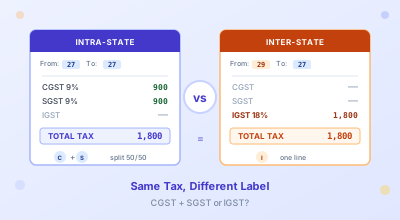
Pull out two GST invoices from your folder and you'll notice something funny. One of them splits the 18% tax into two lines: 9% CGST and 9% SGST. The other shows a single line of 18% IGST. Same rate, same tax amount, same total. Different labels — and the difference is worth understanding before you file.
The good news is that you can tell which one is right in about five seconds, every single time. The rule is baked into the GSTIN itself. Once you know where to look, you'll spot supplier mistakes before they ever hit your books, and you'll stop second-guessing bills that actually have the tax type correct.
The Five-Second Test
Compare the first two digits of the supplier's GSTIN with the first two digits of your own. Same number? Intra-state. The invoice should show CGST and SGST, in equal amounts. Different numbers? Inter-state. The invoice should show a single IGST line. That is genuinely the whole rule.
Let's run it once with actual bills. Your business is registered in Maharashtra, so your GSTIN starts with 27. A supplier in Pune sends you an invoice. Their GSTIN also starts with 27. Same state, so the 18% tax should split into 9% CGST plus 9% SGST. Two tax lines on the invoice, equal amounts. If instead the bill shows a single IGST line, the supplier has got it wrong and the tax has gone to the wrong account.
Now flip the scenario. Same Maharashtra business (27), but this time the supplier is in Bengaluru (29). Different number, so it is inter-state. The 18% tax should sit on a single IGST line. If they have split it into CGST and SGST, the supplier has quietly deposited half the tax to the Karnataka state government and half to the Centre, instead of routing the full IGST to the Centre for later settlement. You cannot book that bill as is.
If you ever forget which state owns which two-digit code, our GST state code list has all 38 codes in one place, with a one-click Excel download if you want a copy on your desktop.
Why the Label Actually Matters
The total tax is the same either way. The distinction exists because GST is technically a shared tax between the Centre and the states, and the split of who gets how much is baked into the labelling. CGST is the Centre's share. SGST is the state's share. IGST is a temporary holding account that the Centre collects first and settles with the destination state later, behind the scenes.
For you as a buyer claiming ITC, the credit is available either way. A wrong tax type on a supplier's bill does not reduce your credit amount. What it does is put the tax into the wrong government bucket, and the only way to fix that is a credit note plus a fresh invoice from the supplier. You cannot unilaterally reclassify the bill from your end. So every wrong-tax-type invoice you let through is one more phone call you will have to make during reconciliation.
Place of Supply: The Rule That Trips Everyone Up
Here is where the five-second test occasionally breaks, and it catches even people who have been doing GST for years. The actual rule is not "where is the supplier, where is the buyer". It is "where is the supplier, where is the place of supply". Those two things are the same for most transactions, which is why the shortcut works. They are not the same for a specific set of situations, and those are the ones worth knowing.
For goods that physically move, place of supply is where the goods get delivered. That is usually the buyer's address, so the shortcut holds. For services, it gets slippery. A Mumbai hotel bills you, and you happen to live in Delhi. Place of supply is Mumbai (where the room is), not Delhi. The hotel's invoice carries CGST and SGST, not IGST, because the service was consumed in Maharashtra. It looks wrong the first time you see it, but it is genuinely correct.
The same logic covers restaurant bills (place where you ate), training sessions (place where the session happened), immovable-property services (where the property is), and tickets for specific events (where the event is). Before flagging a hotel or restaurant invoice as a tax-type error, check whether place of supply overrides the default buyer-location rule.
The Special Cases You'll See on Real Bills
Alongside the CGST-SGST-IGST trio, a few other labels show up often enough to be worth recognising.
UTGST. This replaces SGST on invoices from certain union territories: Chandigarh, Ladakh, Lakshadweep, Andaman and Nicobar, Daman and Diu. The mechanics and the rate are identical to SGST. The label changes because the money is going to a UT administration rather than a state government. Delhi, Puducherry and J&K have their own legislatures, so those still use SGST.
Composition scheme supply. Small businesses registered under the flat-rate composition scheme cannot charge CGST or SGST or IGST separately. Their bills carry a line that just says "composition levy" or similar, and the tax is built into the price. The crucial point is that you cannot claim ITC on a composition-scheme invoice, ever. If the supplier is on the scheme and a client of yours does not understand why their ITC did not go through, this is usually why.
Reverse charge. On a reverse-charge invoice the tax is payable by you, the buyer, not the supplier. The bill typically carries a stamp or a line that reads "tax payable on reverse charge basis". You remit the tax directly and claim the ITC in the same month. Common for legal services from advocates, goods transport agency bills, and certain government-sourced supplies.
Zero-rated supplies. Exports and sales to SEZ units carry no tax at all. The invoice shows the taxable value and then zeros across every tax line. That is correct, not a mistake. If you ever receive such a bill and are unsure, look for the LUT reference or "export" mention near the top.
The Three-Point Check on Every Invoice
For most bills your decision tree is short, and worth running on every supplier invoice until it becomes automatic.
First, pull both GSTINs. Yours and the supplier's. Compare the first two digits. Same, and the invoice should show CGST plus SGST. Different, and it should show IGST.
Second, eyeball the split. On an intra-state bill, CGST and SGST amounts must be identical. A standard 18% rate becomes 9% plus 9%. A 12% rate becomes 6% plus 6%. A 5% rate becomes 2.5% plus 2.5%. If the two numbers are different, something is off, either in the rate or the maths. Our GST calculator is the fastest way to verify whether the bill's arithmetic is honest about itself.
Third, check for exceptions. Is the supplier a hotel, restaurant, or service provider where the service is physically delivered at a specific location? Place of supply may override the default. Is the supplier on the composition scheme? Does the invoice mention reverse charge or zero-rating? Any of those change what "correct" looks like for the bill.
If all three align, go ahead and book it. If something looks off, do not paper over it. Ring the supplier the same day, because a correction that takes one phone call today turns into a reconciliation headache three weeks from now.
When the Supplier Has Got It Wrong
Here is the annoying bit. You cannot fix a wrong tax type on your own end. Once the supplier has charged CGST and SGST on an inter-state sale (or the reverse), the tax has gone to the wrong government account, and the only route out is for the supplier to issue a credit note against the original invoice in their GSTR-1, and then reissue a fresh invoice with the correct labels.
In practice, this is a phone call to the supplier's accounts person. Explain the state codes, point out which tax type should apply, and ask for a credit note in the same filing cycle. Most suppliers are cooperative once they understand. A few will push back because reversing a deposit feels like extra effort at their end. Stay polite and stay firm. Until the credit note and corrected invoice actually land in your inbox, do not book the original bill, because doing so locks you into a reconciliation problem that GSTR-2B will absolutely find during filing.
This is one of the seven classic mistakes I walked through in the common GST invoice errors post, along with the fixes for each.
Catching This at Scale
At five or ten bills a month, eyeballing each invoice for the right tax type is fine. Once you are into fifty or a hundred, tiredness does the thing tiredness always does, and a CGST-plus-SGST line on an inter-state bill slips past you on a Friday afternoon. You find out about it three weeks later when GSTR-2B throws a reconciliation error.
GSTExtract pulls CGST, SGST, and IGST amounts out of every invoice in a batch, compares the state codes of both GSTINs, and flags anything where the tax type does not match the expected intra-state or inter-state pattern. You get one Excel sheet back with the suspicious rows surfaced at the top, so the only ones worth your attention are the handful that actually matter. It is free to try, no signup, just drop in a batch and see what comes back.
Related Tools
- GST Calculator — compute CGST, SGST, IGST for any amount and rate
- GSTIN Validator — verify the structure and check digit of any GST number
- GST State Code List — all 38 codes in one place, with a one-click Excel download
- How to Read a GST Invoice — field-by-field walk-through of every invoice field
- GST 2.0 on Your Invoice — what the 22 September 2025 rate cutover means for your bills
- The GST QR Code on Your Invoice — what the QR encodes and how a 30-second scan catches fake invoices
- 7 Common GST Invoice Errors — the mistakes that quietly kill your ITC
- Place of Supply Under GST — the full rules for goods, services, hotels, transport, and cross-border cases
- How to Find Company Details from a GST Number — the structural breakdown that makes the state-code-to-tax-type rule possible in the first place
Batch-Check Your Invoices for Tax-Type Mismatches
Upload a folder of GST invoice PDFs. Every row gets the state-code cross-check run automatically, and mismatches are surfaced at the top of the sheet.
Convert to ExcelFrequently Asked Questions
How do I know if my invoice should show CGST+SGST or IGST?
Compare the first two digits of the supplier's GSTIN with the first two digits of your own GSTIN. Same number means intra-state, and the invoice should split tax into CGST plus SGST (equal amounts). Different numbers mean inter-state, and the invoice should show a single IGST line. The total tax is the same either way. Only the label and the accounting destination change.
Can one invoice have both CGST+SGST and IGST?
Not for a single supply. Every line item is either intra-state (CGST plus SGST) or inter-state (IGST) based on the place of supply. What can happen is a single invoice with multiple line items where each line is treated separately. A mixed-nature invoice is rare and usually signals that someone has misclassified one of the lines. If you see both tax types on the same bill, re-check the place of supply for each item before booking.
What happens if my supplier charges the wrong tax type?
The tax has been deposited into the wrong government account. You cannot fix this on your end. The supplier has to issue a credit note against the original invoice in their GSTR-1 and reissue a fresh invoice with the correct tax labels. Until that correction lands, you should not book the original bill. Make the phone call the day you spot the error. The longer you wait, the harder it gets to untangle, especially close to filing deadlines.
Why does my hotel bill show CGST+SGST even though I live in a different state?
Because the place of supply for hotel accommodation is the state where the hotel is located, not the state where you live. GST law treats the hotel's room as a Maharashtra service when the hotel is in Maharashtra, even if the guest is from Delhi. The same rule applies to restaurants, training venues, immovable-property services, and event tickets. Always place of supply first, billing address second.
What is the difference between SGST and UTGST?
SGST is charged when the supply is inside a state with its own legislative assembly (most Indian states, plus Delhi, Puducherry, and J&K). UTGST is charged when the supply is inside a union territory without a legislative assembly (Chandigarh, Ladakh, Lakshadweep, Andaman and Nicobar, Daman and Diu). The mechanics and the rate are identical to SGST. The label changes only because the tax is going to a union territory administration rather than a state government.