GSTR-9 for FY 2025-26
Filing the first annual return that straddles the 22 September 2025 GST 2.0 cutover. What changes, what doesn't, and how to land it before 31 December 2026.
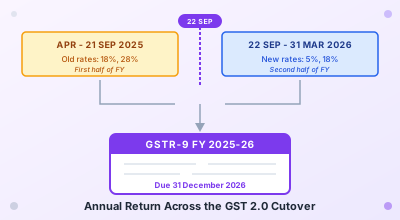
By the second week of December every year, the same pattern shows up at small CA practices. Thirty client annual returns sit half-prepared on someone's laptop, the portal pre-fill numbers don't match the books on six of them, and nobody can figure out why. For FY 2025-26 the gap is going to be wider than usual. This is the first annual return that straddles the GST 2.0 cutover on 22 September 2025, which means rate-wise tables on the portal will carry entries at both old and new rates for any HSN whose slab moved. Toothpaste at 18 percent from April to mid-September, then at 5 percent from October to March, both rows sitting in Table 17 against the same HSN code. Air conditioners the same way, 28 then 18.
The mechanics of filing haven't changed. What's different is that the year was split across two rate regimes, and the reconciliation has to handle both halves cleanly. This post walks through what's different about this year specifically, who has to file, the parts of the return that the cutover touches, the ITC reconciliation under the old soft-match regime, and a realistic October-to-December workflow that doesn't end with you filing at 11 PM on the 31st.
What GSTR-9 Actually Is
GSTR-9 is the annual return. It is not a fresh exercise where you re-enter the year. It's a consolidation of everything you have already filed in your monthly or quarterly GSTR-1 and GSTR-3B, broken into a different set of tables, with reconciliation rows where the year-end view forces you to explain the differences.
The portal pre-fills most of the outward-supply tables (4 and 5) from your GSTR-1, and most of the ITC tables (6 and parts of 8) from your GSTR-3B. Some of the pre-fills you can edit. Others are read-only. The parts that need fresh data entry are the HSN-wise summary in Table 17, the inward HSN summary in Table 18 (above 5 crore only), and the cross-FY adjustment tables 10 to 13.
Here's the part teams miss. The pre-filled number is not authoritative. It's the same data you uploaded all year, laid out differently. If your March GSTR-1 had a B2C row sitting in the wrong rate slab, the pre-fill carries that mistake straight through to Table 4 of GSTR-9 without flagging it. The annual return is where errors of the year either get caught and explained, or they harden into the official record. The portal makes the pre-fill look like the answer. It's the question.
Who Must File
GSTR-9 is mandatory once your aggregate turnover crosses 2 crore for FY 2025-26. Below that, filing is technically optional, carried over from Notification 47/2019 and continued every year since. Most practising accountants file for sub-2-crore clients anyway, because skipping the annual return leaves the year-end shutdown undocumented and any future audit officer who notices the absence is going to ask about it.
The reconciliation statement, GSTR-9C, kicks in at 5 crore. Since FY 2020-21 it has been self-certified rather than CA-audited (the audit requirement was dropped that year), though the form still asks for the reconciliation between audited books and what was filed through the year. If you cross 5 crore for FY 25-26, you file 9 and 9C together. And the threshold is on aggregate turnover at the PAN level, not on the single registered GSTIN, so a company with multiple state registrations is summed across all of them.
Composition dealers fill GSTR-9A instead, which is a much smaller form. Casual taxpayers, non-resident taxpayers, ISDs, and OIDAR providers don't touch GSTR-9 at all.
The GST 2.0 Problem on This Year's Return
The 22 September 2025 cutover splits FY 2025-26 into two halves. Outward supplies in Tables 4 and 5 are reported rate-wise. The HSN-wise summary in Table 17 is also rate-wise. Any HSN whose slab moved on the cutover date will need separate rows for the pre-cutover and post-cutover periods.
A toothpaste wholesaler with HSN 3306 will report April-to-September sales at the 18 percent slab and October-to-March sales at the 5 percent slab, both rows under the same HSN. An air-conditioner distributor with HSN 8415 has the same shape with 28 and 18. Cement (HSN 2523), branded namkeen (HSN 2106), portable DG sets, salty snacks in retail packs — the list of slab-changers is long enough that most multi-product wholesalers will see at least one or two HSNs splitting into two rows in their Table 17. Service businesses are mostly spared. Consulting, SaaS, advocate services, freight forwarding, none of these moved on the cutover, so a pure-services GSTR-9 looks pretty much the way it did last year.
Straddle invoices are where teams lose time. An invoice dated 25 September 2025 for goods that were dispatched on 20 September has its time of supply on 20 September under the standard rule, which means the old rate applies even though the invoice paper has a post-cutover date. The annual return reflects whatever was filed in GSTR-1 for that bill. If GSTR-1 reported it at the new rate because the team only looked at the invoice date and not the time of supply, the error has been propagating since September and surfaces in Table 17 reconciliation against your dispatch register. The fix is an amendment in the current-FY return (Tables 10 to 13), not a quiet re-entry in the annual return itself.
Credit notes against pre-cutover invoices, issued after the cutover, carry the rate of the original invoice. A credit note issued in November 2025 against a July 2025 invoice for toothpaste runs at 18 percent, not 5 percent, because the credit note reverses the original tax. These end up in Table 4I (credit notes issued) at the old rate. Get this wrong and the credit note sits under the wrong rate slab in Table 17 too, and the year's rate-wise turnover doesn't tie back to the books.
ITC Reconciliation and the Soft-Match Regime
Tables 6, 7, and 8 are the ITC half of the return. Table 6 captures what you actually claimed in your monthly 3B through the year, with import IGST, RCM, ISD credit, and ordinary domestic ITC all on their own lines. Reversals sit one table down in Table 7, which is where the Section 17(5) blocked credits and the Rule 42/43 proportionate reversals get their year-end tally. Then there is Table 8. Nobody loves Table 8. It's the reconciliation that asks why your 2A aggregate for the year doesn't match what you claimed in 3B, and the answer goes in 8C through 8K with a row for each named reason.
For FY 25-26 specifically, this reconciliation is going to look more relaxed than future years will allow. The Zero Mismatch Policy that hard-locks GSTR-3B at the 2B value only started on 1 April 2026, which is FY 2026-27. Through all of FY 25-26 you were operating under the soft-match regime, which meant suppliers who filed their GSTR-1 late, or made invoice errors that got corrected over a quarter or two, generated 2A and 2B differences that you could still resolve over multiple months. Those residual differences roll up into Table 8C (ITC of FY 25-26 claimed in the April-October 2026 returns of FY 26-27 under the Section 16(4) window) and 8D (the leftover difference once 8A minus 8B minus 8C is computed, which is the actual leakage that needs an explanation in 8E for "available but not availed" or 8F for "available but ineligible").
Worth pausing on this one. The FY 25-26 annual return is the last one where you can show 2A-to-3B differences as routine reconciliation work without the portal having blocked your filing along the way. From FY 26-27 onwards, the same Table 8 still exists on the form, but because the underlying 3B was already hard-locked at 2B monthly, the residual differences are going to be tiny. This year is the cleanup year. Use the explanation rows in 8E and 8F for real, because next year there will be hardly anything to explain.
The RCM Corner That Gets Missed
Table 6F covers ITC availed on reverse-charge inward supplies on a self-invoice. RCM transactions don't appear in your 2A or 2B because there is no supplier-side GSTR-1 to pull from. The self-invoice is your own document for your own books. Teams that handle RCM through occasional consultant payments, GTA freight, advocate fees, or director sitting fees will have a Table 6F number that the pre-fill cannot help with. It has to be assembled by going back through the 3B cash and credit ledger entries for the year and pulling the RCM lines.
This is also where the Section 9(3) and 9(4) split gets reported separately under 6C and 6D in the broken-down version of the table. Section 9(3) is notified RCM on specific categories (GTA, advocate, sponsorship, etc.); 9(4) is unregistered-supplier RCM. If your books were sloppy about distinguishing the two through the year, the annual return is where you fix the classification. In my experience this is the single most common ITC slip on small-business returns, and it gets caught in audit more often than people expect.
GSTR-9C If You're Above the 5 Crore Threshold
GSTR-9C is short on principle and long on judgment. It reconciles audited turnover from the books to the turnover reported in GSTR-9, lists the differences in Part II (turnover) and Part III (tax), and asks for each material difference to be named and explained.
Differences that are normal and explainable: unbilled revenue accrued at year-end, deemed supplies under Schedule I that didn't go into invoices, foreign exchange gains and losses on export realisations, free samples that count as supply under GST but not as turnover in the books. The list of legitimate reconciliation items is well-trodden ground for any accountant who has done a couple of 9Cs before.
The self-certification format is simpler than the old CA-audit format, but the underlying reconciliation discipline is the same. If your books say 52 crore and GSTR-1 says 50 crore, that 2 crore difference has to be sitting in a named explanation row, not a residual unexplained variance. The portal accepts a 9C with unexplained differences. Audit officers don't.
A Realistic October-to-December Workflow
Start in October. Pull the GSTR-1 summary, GSTR-3B summary, and the books for the full year. The portal makes a draft pre-filled GSTR-9 available by autumn (usually around August or September once the form is notified for the year). That draft is what you reconcile against.
November is the slow work. Match turnover by month between books, GSTR-1, and 3B. Identify rate-wise mismatches in Table 17 that the GST 2.0 straddle has introduced. Pull your 2A annual aggregate and reconcile against your ITC claims. Tag late-claimed ITC for Table 8C and split your residual 8D leakage into 8E and 8F. Pull out the RCM self-invoices for the year and aggregate them into the Table 6F figure. If anything looks off, the November buffer is where you fix it through current-FY amendments.
December is filing month, not preparation month. Show up at 28 December with reconciliation still pending and you'll either rush it (and errors harden into the record) or miss the 31st (late fee starts ticking). The last week of December is also when portal traffic peaks and form submissions slow to a crawl. File by 20 December if you can. Treat the last ten days as buffer for late corrections, not as headroom for fresh work.
Due Date and the No-Revision Rule
31 December 2026 for FY 2025-26. Filing after that triggers late fee under Section 47(2): 100 rupees per day under CGST plus 100 rupees per day under SGST, so 200 rupees per day stacked. The 53rd GST Council meeting in 2024 rationalised the caps for smaller businesses, but the cap for upper-tier turnover (above 20 crore) sits at 0.5 percent of state turnover, which is meaningful even by mid-January if you haven't filed. Interest under Section 50 also runs on any additional tax payable revealed by the reconciliation, calculated from the original due date of the relevant monthly 3B and not from 31 December.
And here's the rule that matters more than the late fee. GSTR-9 cannot be revised once filed. If the reconciliation in the annual return reveals additional tax payable, you pay through DRC-03 with interest. If it reveals that ITC was under-claimed, the Section 16(4) time-bar has usually already passed by then (30 November of the year following the relevant FY, so 30 November 2026 for FY 25-26, which is before the annual return is even due).
This is the practical reason the annual return is not the place to discover surprises. The surprises should have been discovered and corrected during the year, in the monthly returns where amendment is still possible. The annual return publishes the cleaned-up year-end view and accepts that it stands as filed. December is the wrong time to find a problem from June.
Pulling Vendor Invoice Data for Table 17 Reconciliation
If you're reconciling Table 17 against vendor PDFs scattered across email and folders, GSTExtract pulls vendor name, GSTIN, invoice number, date, total, and tax breakdown out of each bill into Excel in seconds. Free to try.
Try the ExtractorRelated Tools
- GST Invoice to Excel — pull vendor name, GSTIN, invoice number, date, total, and tax fields out of supplier PDFs for Table 17 and Table 8 reconciliation
- GSTIN Validator — structural check on supplier GSTINs that show up in your ITC reconciliation
- HSN Code Lookup — verify HSN codes and GST 2.0 rates for the rate-wise rows in Table 17
- GST Calculator — CGST/SGST/IGST split and reverse-tax helpers for working through reconciliation lines
- GST 2.0 on Your Invoice — old rates, new rates, and the 22 September 2025 cutover that creates the rate-wise split in this year's Table 17
- GSTR-2B Reconciliation in Excel — the monthly reconciliation that feeds Table 8 at year-end, with the April 2026 Zero Mismatch Policy in detail
- 7 Common GST Invoice Errors — the catalogue of supplier-side mistakes that surface in your annual reconciliation
Year-End Invoice Data, in Bulk
Drag in a folder of vendor PDFs and download one Excel with vendor, GSTIN, invoice number, date, total, CGST, SGST, and IGST per row. Built for the November reconciliation push.
Try the ExtractorFrequently Asked Questions
Do I have to file GSTR-9 if my turnover is below 2 crore?
Filing is optional below 2 crore aggregate turnover for FY 2025-26, under the waiver carried over from Notification 47/2019 every year since. Most practising accountants file anyway for sub-2-crore clients. Skipping the annual return leaves the year-end shutdown undocumented, and any future audit officer who notices the absence is going to ask about it. The work involved on a clean sub-2-crore set of books is small, and the cost of having an unfiled annual return show up in a later audit notice is larger than the few hours it takes to file.
How does the GST 2.0 cutover affect GSTR-9 for FY 2025-26?
Any HSN whose rate slab moved on 22 September 2025 will need separate rate rows in Table 17 of GSTR-9, one for the April to mid-September period at the old rate and one for the late September to March period at the new rate. The rate-wise outward-supply tables in Part II (Tables 4 and 5) work the same way. Toothpaste HSN 3306 at 18 then 5, air-conditioner HSN 8415 at 28 then 18, cement HSN 2523 at 28 then 18, the list of slab-changers is long enough that most multi-product wholesalers will see at least one HSN splitting into two rows. Straddle invoices and credit notes against pre-cutover bills are the corners where teams lose time, since the rate follows the time of supply or the original invoice rate, not the document date.
What is the difference between GSTR-9 and GSTR-9C?
GSTR-9 is the annual return itself, a consolidation of everything you have already filed through the year in GSTR-1 and GSTR-3B, broken into a different set of tables. GSTR-9C is the reconciliation statement between your audited books of accounts and the GSTR-9 you have just filed, with the differences (deemed supplies, unbilled revenue, FX gains, free samples that count as supply) named and explained. GSTR-9 is required above 2 crore aggregate turnover. GSTR-9C kicks in at 5 crore. From FY 2020-21 onwards, 9C is self-certified by the taxpayer rather than CA-audited.
What is the due date for GSTR-9 for FY 2025-26?
31 December 2026. Filing after that triggers a late fee under Section 47(2): 100 rupees per day under CGST plus 100 rupees per day under SGST, capped at a percentage of state turnover (the cap was rationalised by the 53rd GST Council for smaller businesses, but for upper-tier turnover the 0.5 percent cap is meaningful by mid-January). Interest under Section 50 also runs on any additional tax payable revealed by the reconciliation, calculated from the original monthly 3B due date and not from 31 December. Practical advice is to plan filing for the third or fourth week of December, not the last week, because portal congestion in late December is bad every year.
Can GSTR-9 be revised after filing?
No. GSTR-9 is a one-shot final-state document with no amendment route on the portal. If the reconciliation reveals additional tax payable that you missed during the year, you pay through DRC-03 with interest. If it reveals that you under-claimed ITC, the Section 16(4) time-bar has usually already passed by then (30 November of the following FY, so 30 November 2026 for FY 25-26), which is before GSTR-9 itself is due. This is the practical reason that the annual return is not the place to discover surprises. Surprises should be found and corrected during the year, in the monthly returns where amendment is still possible. The annual return publishes the cleaned-up year-end view and accepts that it stands as filed.