GST 2.0 on Your Invoice
Old rates, new rates, and the 22 September 2025 cutover. How to read both without getting confused.
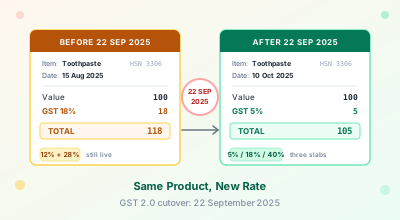
Two bills for the same tube of toothpaste. Same shop, same brand, same 100 rupee MRP. The August 2025 one shows 18% GST. The October 2025 one shows 5%. Thirteen percentage points, just gone. If your first reaction is "wait, which one is wrong", fair enough, that's the first reaction every accountant I know had when they started seeing these bills pile up. Neither one is wrong. What changed between those two dates is a thing the government calls GST 2.0, and most of the noise around it has settled by now. What remains is the question you actually care about: how do you read these bills without second-guessing every one.
This post walks through exactly that. The cutover date, which slab moved where, the rule that decides which rate applies when, and the awkward straddle cases that catch people out. By the end you should be able to look at any GST invoice in your folder, check its date, and know at a glance whether the rate on it is doing the right thing.
What GST 2.0 Actually Changed
For eight years we lived with a rate list nobody could quite keep straight. Four slabs at 5%, 12%, 18%, and 28%. Plus zero-rating. Plus special rates on a few items that refused to fit anywhere else. Plus the compensation cess sitting on top of 28% for the luxury and sin end of the shelf. Anyone who has ever had to explain to a client why sanitary napkins sat at 12% but certain mattresses sat at 28% knows the list was messier than it needed to be. The GST Council finally agreed, and on 3 September 2025 it signed off the rewrite. The new list kicked in on 22 September.
Two slabs got killed. The 12% slab and the 28% slab both vanished from the rate schedule. Items that used to sit in 12% mostly moved down to 5%. Items that used to sit in 28% mostly moved down to 18%. A new 40% slab got added at the top, covering luxury and sin goods that used to carry 28% plus a compensation cess. The end state is three everyday slabs that most people will ever see on their invoices: 5%, 18%, 40%. And zero for exempt supplies.
If you had to remember one thing, it's this: 12 and 28 are gone from new invoices, but they're still perfectly fine on old ones.
Which Items Actually Moved
Not every item shifted. Plenty stayed exactly where they were. The ones that moved, though, are the ones you deal with most often.
The biggest visible change was FMCG. Hair oil, shampoo, toothpaste, soap, shaving cream, face powder, toothbrushes, all of those dropped from 18% to 5%. This is why your monthly kirana bill has been noticeably lower since late September. Kitchenware, umbrellas, bicycles, combs, bamboo furniture, feeding bottles, tableware, pre-packaged butter and ghee and cheese and namkeens, those all moved from 12% to 5%. Same shelf, different sticker.
If you bought a fridge on the evening of 21 September 2025 you paid about eight thousand rupees more than you would have twelve hours later. The showrooms that week were a minor circus, and the 28%-to-18% move was what that circus was about. Air conditioners, televisions larger than 32 inches, refrigerators, washing machines, dishwashers, monitors, projectors, cement, small cars (petrol up to 1,200cc, diesel up to 1,500cc), motorcycles below 350cc. Every one of those dropped ten percentage points in one night.
Then there's the new 40% slab at the top. Most small businesses will never touch it, which is the whole point of how it was designed. It's where tobacco, gutka, pan masala, aerated and caffeinated beverages, luxury cars and SUVs, motorcycles above 350cc, yachts, helicopters, private jets, and online gambling now live. If a 40% line shows up on one of your invoices and you don't deal in any of the above, something is off. Check the HSN twice before you book it.
The Rule That Decides Which Rate Applies
In practice you can nearly always just look at the invoice date. 21 September 2025 or earlier, old list. 22 September 2025 or later, new list. Done.
The textbook version is a little fussier than that. The time-of-supply rule says the rate is decided by the earlier of the invoice date or the payment date for goods, with the completion-of-service date added in for services. Good to know if you ever end up in a dispute, but honestly, I have yet to see a real-world case on a straightforward transaction where the textbook answer and the invoice-date answer differ. Where it does matter is the small pocket of transactions that had money changing hands on one side of the cutover and goods moving on the other. Advances received in August, supply fulfilled in October. Orders placed on 20 September, invoice raised on 25 September. Those are the straddle cases, and they deserve a section of their own.
Straddle Invoices and the Credit-Note Fix
Say a customer paid you a 100 rupee advance on 15 August 2025 for an order that was going to be delivered in October. At that point the rate was 18%, so you collected 18 rupees in tax and deposited it. The supply actually happens on 10 October 2025, by which time the rate has dropped to 5%. You raise an invoice for the full supply at 5%. What about the 13 rupees of extra tax you already paid?
The CBIC's guidance on this is to issue a credit note against the original advance, adjusting the liability. In practice, your accounting software probably handles most of this, but you need to watch the numbers on both sides. The invoice ends up with an advance-adjustment line alongside the main tax line, and the two have to net out to the correct new-rate liability. If you see a post-September invoice with what looks like an odd adjustment against an old advance, that's the supplier doing the right thing. Read the bill end-to-end, not just the headline tax amount.
The reverse case (rate went up, advance collected at the old lower rate, supply post-cutover) applies almost entirely to the handful of items that got bumped from 28% plus cess to 40%. For most of us this is a non-issue. For anyone in the tobacco or aerated-beverages trade, talk to your CA.
Reading Old Invoices in Your Archive
Here's the bit I see people getting needlessly worried about. You have a folder (digital or physical) full of 2024 and early 2025 invoices showing 12% and 28% GST on various line items. After GST 2.0 kicked in, some people started wondering if these bills are now somehow tainted. They're not.
An invoice is valid for the rates that were in force on its date. A toothpaste bill dated 15 August 2025 carrying 18% GST is correct. A fridge bill dated 4 March 2025 carrying 28% GST is correct. You can still book ITC on them. You can still use them for reconciliation. You can still produce them in audits three years from now and they'll be accepted without a quibble. The only bills you should cast a second look at are the ones dated 22 September 2025 or later that still show 12% or 28%. Those are the ones where the supplier has carried over a stale rate in their billing software.
The cleanest way to audit your archive for this is by HSN code. HSN codes didn't change in GST 2.0. What changed is the rate mapped to each HSN. If you pull every invoice for HSN 3306 (dental hygiene products, which covers toothpaste) from the last twelve months, you should see 18% on every pre-cutover bill and 5% on every post-cutover bill. Anything else is worth a phone call.
Spotting a Wrong Post-Cutover Invoice
The most common mistake I've run into since September is suppliers whose billing software didn't get the memo. A small vendor who invoices through a three-year-old Excel template or a legacy Tally setup will sometimes keep printing 12% or 28% on lines that should now be 5% or 18%. Three things to look for on any invoice dated after 22 September.
First, a line item carrying 12% or 28% that you recognise as an FMCG or consumer-durable product. That's a stale rate. Ring the supplier and ask for a corrected invoice.
Second, tax amounts that don't match the declared rate. Honestly this is usually an arithmetic slip rather than a rate-table error, but it's worth catching either way. Do the maths yourself if you need to, or use our GST calculator to verify whether 5% on the taxable value actually produces the tax amount on the bill.
Third, a mismatch between HSN and rate. Toothpaste with a 3306 HSN code showing 18% on an October invoice is wrong. Hair oil on HSN 3305 showing 18% on an October invoice is wrong. If the HSN says the product and the rate says something else, the invoice needs fixing before you book it.
What This Means for Reconciliation
If you're on the accounting side of this and running monthly GSTR-2B reconciliation, the one thing to flag on your workpaper for FY 2025-26 is the cutover band of roughly mid-September to mid-October 2025. That's the window where straddle invoices, advance adjustments, and the first wave of miscategorised bills all pile up at the same time. Spending forty minutes more than usual on that month pays for itself.
For FY 2026-27, life is simpler. Everything after 1 April 2026 is on the new rate list. The only reason old rates show up in your books now is either a genuinely backdated invoice (rare) or a supplier mistake (not rare). At scale, flagging these by hand gets old quickly.
Catching This at Scale
Eyeballing the rate on every invoice works fine at ten or fifteen bills a month. Somewhere past fifty, tiredness does what tiredness always does, and a 12% line on an October invoice slips through on a Friday evening. You find out about it when GSTR-2B throws a mismatch three weeks later.
GSTExtract pulls the GST rate, CGST, SGST, IGST, and HSN code out of every invoice in a batch and flags anything where the declared rate doesn't match the new-rate list for the invoice date. You get one Excel sheet back with the suspicious rows surfaced at the top, so the only ones worth a closer look are the handful that actually matter. Free to try, no signup, drop in a batch and have a glance.
Related Tools
- GST Calculator — verify the arithmetic on any line at any rate, old or new
- GSTIN Validator — check the structure and check digit of any GST number
- GST State Code List — all 38 codes, with an Excel download
- How to Read a GST Invoice — field-by-field walk-through of every invoice field
- CGST vs SGST vs IGST on Your Invoice — which tax label your bill should carry
- Place of Supply Under GST — the rule that decides intra-state vs inter-state, with goods and service carve-outs
- 7 Common GST Invoice Errors — the mistakes that quietly kill your ITC
- The GST QR Code on Your Invoice — what the QR encodes and how a 30-second scan catches fake invoices
- HSN Code Lookup — the cutover moved a long list of rates without changing HSN codes; here is how to update your master correctly
- GSTR-9 for FY 2025-26 — the first annual return that straddles the cutover, with rate-wise Tables 4, 5, and 17 carrying entries at both old and new slabs for the same HSN
Scan Your Archive for Stale-Rate Invoices
Upload a folder of GST invoice PDFs. Every row gets the rate checked against the correct slab list for its invoice date, and stale rates are surfaced at the top of the sheet.
Convert to ExcelFrequently Asked Questions
Why does my toothpaste bill from August 2025 show 18% GST but the October bill shows 5%?
Because the GST Council rewrote the rate list on 22 September 2025 and toothpaste moved from the 18% slab to the 5% slab. The reform, usually called GST 2.0, killed the 12% and 28% slabs, kept 5% and 18%, and added a new 40% slab for luxury and sin goods. The rate printed on your bill depends on the date of supply, not the date you walk into the shop. An August invoice at 18% is correct. An October invoice at 5% is also correct. Neither one is a mistake.
What rate applies if I paid an advance in August but received the goods in October?
The new rate applies to the actual supply, and the old-rate tax you already paid on the advance gets adjusted through a credit note the supplier issues against that advance. In plain terms: the supplier writes off the 18% they collected in August, raises a fresh invoice at 5% for the October supply, and the two lines net out. If an October invoice lands on your desk with what looks like an odd adjustment against an old-rate advance, that's the supplier doing the right thing, not a mistake. Read both lines together, not separately.
Are my old 12% and 28% invoices from before September 2025 still valid?
Yes. Fully valid. An invoice dated on or before 21 September 2025 showing 12% or 28% GST is legally correct because those slabs existed on that date. You can book ITC on it, produce it in audits, use it for reconciliation, all of that works normally. The 12% and 28% labels disappeared from new invoices after 22 September. They didn't disappear from old ones.
What is the new 40% GST slab for?
Mostly for stuff you're unlikely to be buying for the office. It's a consolidated rate for luxury and sin goods: tobacco, gutka, pan masala, aerated and caffeinated beverages, luxury cars and SUVs, motorcycles above 350cc, yachts, helicopters, private jets, and online gambling. It replaced the old 28%-plus-compensation-cess combination on these items, so the headline number looks bigger but the actual tax burden ends up roughly comparable. If a 40% line shows up on one of your invoices and you aren't dealing in any of the above, check the HSN code before you book the bill.
Did HSN codes change in GST 2.0?
No. The HSN code identifies the product, not the rate, so your old HSN stays the same after GST 2.0. What changed is the rate mapped to that HSN. This is genuinely useful for reconciliation. If you pull the same HSN from invoices dated before and after 22 September, the items line up cleanly and the only difference is the rate column. That's the single cleanest way to audit your archive for the transition.