7 Common GST Invoice Errors That Cost You Money
Most invoice errors are caught during GSTR-2B reconciliation — weeks after you've already accepted the invoice. By then, fixing them costs time, money, and supplier goodwill.
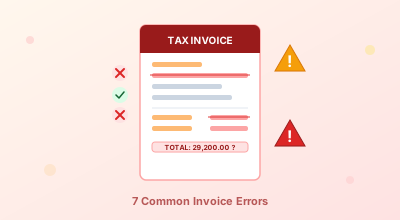
Every business that claims Input Tax Credit knows the feeling. You sit down to file your return, you run reconciliation, and within ten minutes GSTR-2B is quietly telling you that three of your invoices don't match. One has a typo in the supplier's GSTIN. Another shows CGST and SGST when it should have been IGST. The third has tax math that just refuses to add up. The deadline is on Friday, the supplier's accounts person stops picking up the phone after 5 PM, and you can already feel the weekend slipping away.
The maddening part is that almost none of these errors are unavoidable. They're the same handful of mistakes, repeated across thousands of bills every month, and most of them can be caught in seconds if you know what to look for. Here are the seven I see most often, what each one really costs you, and how to spot them before they ever reach your return.
1. The GSTIN With One Wrong Character
This one alone accounts for more denied ITC claims than everything else on the list put together. The supplier's GSTIN on your invoice has to match, character for character, what they file in their own GSTR-1. One mistyped letter in the PAN portion, a swapped state code, a stale check digit, and GSTR-2B will simply tell you "no matching invoice found." Not "close enough." Not "did you mean…". Just nothing.
The fix is genuinely the boring part. Before you accept a bill from any new supplier, take five seconds to verify the GSTIN. Run it through a GSTIN validator, confirm the state code matches where the supplier is actually based, and you've already eliminated the most expensive mistake on this list.
2. The Inter-State Sale With CGST and SGST On It
I keep hoping this one will go away with time, and it just doesn't. A supplier in Bengaluru (state code 29) sends you, sitting in Mumbai (state code 27), an invoice that proudly splits the tax into CGST and SGST. That's wrong. It should be a single IGST line. The first two digits of each party's GSTIN tell you everything: if they're the same, it's intra-state; if they're different, it's inter-state. Same equals CGST plus SGST. Different equals IGST. That's the entire test.
Here's why the error matters. When a supplier mis-charges CGST and SGST on an inter-state sale, the tax has been physically deposited into the wrong government account. You can't claim ITC against it until they cancel the bill with a credit note and reissue a corrected one with IGST. So you're not just filing a dispute, you're effectively waiting on the supplier's accounts team to do paperwork they really don't want to do. If you can't remember which state owns which two-digit code, our state code list is the fastest way to check. For the full walk-through of this rule (including the place-of-supply cases that trip people up), see our piece on CGST vs SGST vs IGST on your invoice.
3. The Tax Maths That Doesn't Add Up
This one is the most embarrassing because it's the easiest to catch. The rule is just primary school arithmetic: taxable value times the rate should equal the tax shown on the invoice. Forty thousand rupees at eighteen percent comes to ₹7,200 of IGST. Not ₹7,000. Not ₹7,250. Exactly ₹7,200.
So why does this error show up so often? Two reasons, in my experience. The first is multi-line bills where each line item is rounded individually and the totals end up drifting by ten or twenty rupees. The second is discounts applied in the wrong order — if a supplier knocks off a discount after computing tax instead of before, the printed totals stop tying to the line items. A quick run through a GST calculator will tell you whether the bill in your hand is honest about its own arithmetic.
4. The Invoice With No Real Invoice Number
An invoice number isn't a label suppliers get to be creative about. The CGST Rules require it to be unique, sequential, and capped at sixteen characters per financial year. In practice, two related problems show up: the invoice that doesn't have a proper number at all, and the invoice that has the same number as one you've already seen.
The first one usually looks innocent. You'll get a bill that prints something like "Receipt #2384" or "Order ID 90047" at the top, with no obvious invoice serial anywhere. Without a real invoice number, you have nothing to put in the GSTR-2 reference column, and the bill becomes effectively unbookable. The second is rarer but more painful: a supplier accidentally reusing a number means GSTN throws a duplicate flag the moment they upload it, and the second bill is silently dropped from their GSTR-1. The fix is to make a quiet rule for yourself — every supplier bill gets a glance for "is there a clearly labelled invoice number, and have I seen this exact one before?"
5. The Bill That Lands in the Wrong Return Period
The date on an invoice, not the date you opened the email, decides which return period the bill belongs to. An invoice dated 31 March 2026 is part of the March 2026 return — even if it sat unread in your inbox until 5 April. If your supplier files it in their March GSTR-1 and you cheerfully book it into April, the timing won't reconcile and your accountant gets to spend a satisfying hour figuring out why.
The trap to watch for is the cluster of bills that arrive in the first week of every month. Pay close attention to the date stamp: if it falls in the previous month, the invoice goes into the previous month's return, not the current one. It feels like a small thing, but it adds up over a year.
6. The HSN Code That Doesn't Belong on This Item
The HSN code (for goods) or SAC code (for services) is what tells the GST system which rate to apply. Get the code wrong, and you risk getting the rate wrong too. The rate mistake is usually the more painful half. A few examples of the kinds of mix-ups I've seen on real bills:
| Product | Correct HSN | Correct Rate | Wrong HSN | Wrong Rate |
|---|---|---|---|---|
| Laptop | 8471 | 18% | 8443 (Printer) | 18% |
| Office Chair | 9401 | 18% | 9403 (Other furniture) | 18% |
| Packaged Food | 2106 | 18% | 0901 (Unprocessed) | 5% |
Sometimes the rates happen to land in the same slab and the bill looks fine on the surface — but the wrong HSN will still cause headaches the moment a detailed reconciliation or an audit happens. When the rates don't match, the consequences are concrete: you're either overpaying tax, or you're under-claiming the credit you were entitled to.
7. The Supplier Name That Doesn't Quite Match
The name printed on the invoice ought to match the name on the supplier's GST registration. Sounds obvious, and yet I see this mismatch on a startling number of bills. The usual culprits are trading names versus legal names ("QuickMart" on the bill, "QuickMart Retail Solutions Pvt Ltd" on the certificate), shortened forms ("ABC Ltd" instead of the full "ABC Private Limited"), and the parent-versus-subsidiary slip where the holding company's name shows up on a subsidiary's invoice.
By itself, a name mismatch usually won't block your ITC. But it creates noise during reconciliation, and noise is exactly what auditors love to ask questions about. If the name on the bill doesn't square with what appears next to that GSTIN in GSTR-2B, take a minute to figure out why before you book it.
A Three-Check Habit That Catches Almost Everything
Honestly, you don't need to memorise all seven errors as separate items. They collapse into three quick checks, and if you make a habit of running them on every supplier bill, you'll catch the vast majority of problems before they hit your books.
The first check is the GSTIN. Run it through a validator, confirm the structure and checksum, and confirm the state code lines up with the supplier's actual location. The whole thing takes about ten seconds. The second check is the tax. Eyeball the maths: does the taxable value times the rate equal the tax shown, and is the right tax type (CGST plus SGST versus IGST) being charged for the inter or intra-state nature of the deal? A GST calculator is the easy way to do this without thinking too hard. The third check is dates and numbers — make sure the invoice date sits in the period you're going to claim it in, and make sure the invoice serial isn't a duplicate of something you've already booked.
Three checks. Maybe a minute per bill. The problem, of course, is that "a minute per bill" times two hundred bills is the better part of a working day. Which brings us to the obvious question.
What If You Stopped Doing This By Hand?
This is roughly why GSTExtract exists. The tool reads your PDF invoices, pulls out the GSTIN, the invoice number, the date, the amounts and the tax breakdown, and runs the checks above for you in the background. Anything that doesn't validate cleanly gets flagged for a human to look at, instead of every bill demanding your attention. It's free to try, no signup, no installer — try it on a real batch from your own folder and see what comes back.
Related Tools
- Verify GST Number — validate any GSTIN's format, state code, and check digit
- GST Calculator — calculate CGST, SGST, IGST for any amount and rate
- GST State Code List — all 38 codes in one place, with an Excel file you can download
- How to Read a GST Invoice — field-by-field guide to understanding every invoice field
- CGST vs SGST vs IGST on Your Invoice — the five-second test that tells you which tax type applies
- Place of Supply Under GST — rules for goods, services, and the edge cases behind wrong-tax-type invoices
- GST 2.0 on Your Invoice — the 22 September 2025 rate cutover, explained with real examples
- The GST QR Code on Your Invoice — what the QR encodes and how a 30-second scan catches fake invoices
- GSTR-2B Reconciliation in Excel — the six-day window between 14th and 20th, three exception buckets, and the workflow that beats the April 2026 hard lock
- HSN Code Lookup — picking the right HSN, the digit-count rule, and the same-code-different-rate trap that catches a lot of small businesses
- How to Find Company Details from a GST Number — the cancelled-vendor problem and when a portal check is non-negotiable
- Fresh Invoice Series for FY 2026-27 — Rule 46(b) on the invoice number itself, the April reset trap, and the credit-note carry that catches people in May
- GSTR-9 for FY 2025-26 — how these invoice-side mistakes surface at year-end in the annual return reconciliation, where they either get explained or harden into the record
Stop Missing Invoice Errors
Upload any GST invoice PDF and get all fields extracted, validated, and exported to Excel in seconds.
Convert to ExcelFrequently Asked Questions
What happens if my GST invoice has errors?
If something on the invoice is off — a wrong GSTIN, the wrong tax type, mismatched figures — the bill won't reconcile against GSTR-2B, and your ITC claim on it gets denied. The only real fix is to go back to the supplier and ask for a credit note plus a corrected invoice. You can't patch the original yourself, no matter how minor the error looks.
How do I fix a wrong GSTIN on an invoice?
You can't, unfortunately. Once an invoice is issued with the wrong GSTIN, the supplier has to cancel it in their GSTR-1 by issuing a credit note against the original, and then issue a fresh invoice with the corrected GSTIN. Your job is mostly to chase them politely until that happens, ideally before the filing deadline.
Can I claim ITC on an invoice with calculation errors?
In theory, yes — if the supplier has reported the bill in their GSTR-1 and it shows up in your GSTR-2B, the ITC is available. In practice, that's a bad idea. The moment the printed tax doesn't equal taxable value times rate, you've baked in a reconciliation problem that an auditor will find later. It's almost always cheaper to get the bill corrected first and claim against the clean version.
How many days do I have to get a corrected invoice?
There's no specific deadline for the correction itself, but the deadline for claiming ITC is real. You have until the earlier of (a) the due date for filing the September return of the next financial year, or (b) the date you file the annual return. So a January 2026 invoice has to have its ITC claimed by the September 2026 return, which usually gets filed in October 2026. Don't wait until the last week — get corrections sorted long before the cutoff, because the supplier's accountant will be drowning by then too.