Place of Supply Under GST
The rule that decides whether your invoice carries CGST+SGST or IGST, and which state government keeps the money. Goods, services, and the edge cases that catch people out.
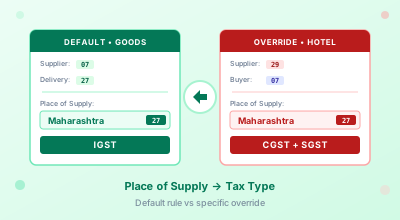
A supplier in Bengaluru sends you a hotel bill for a two-night Mumbai stay. It carries CGST and SGST at Maharashtra rates, and the supplier is right. Your Delhi-registered business is the buyer, the hotel is in Maharashtra, and somehow the tax ended up as an intra-state Maharashtra split. None of the state codes match and the invoice is still correct.
This is the place-of-supply rule in action. It's the quiet second step of the GST engine. When it works you never notice it. When it doesn't, it's one of the most expensive invoice mistakes to unwind, because everything on the face of the bill can look fine. The rule lives in Sections 10, 12 and 13 of the IGST Act: one default for goods, one default for services, and a long list of carve-outs that override both. I ended up writing this post for myself first, because I got tired of re-deriving the logic every time a hotel or training bill looked wrong. Here's the full picture, by transaction type, from the common cases to the ones that catch out people who have filed returns for years.
Why the Rule Exists at All
GST is a destination-based tax. The state where consumption happens gets the SGST share, not the state where the supplier sits. Without a place-of-supply rule there'd be no way to pick which state that is. So the law defines one for every transaction type, and the invoice has to follow the definition. The supplier's state tells you where CGST goes (to the Centre, split later). The place of supply tells you where SGST, or the SGST-portion of an IGST line, ends up.
For the buyer claiming ITC, the credit amount is the same either way. What changes is which government account the tax landed in. Get it wrong and the tax has been deposited in the wrong pocket. ITC still works on paper, but GSTR-2B throws a reconciliation mismatch because the flow doesn't line up with what the seller filed. That's the mess the rule exists to prevent, and it's why a place-of-supply error is harder to catch on a surface read than, say, a wrong rate.
Goods: The Default Rule
Section 10(1)(a) of the IGST Act covers the bulk of real-world goods transactions. If the supply involves movement of goods, place of supply is the state where the goods are delivered. That's almost always the buyer's state, which is why the shortcut of comparing state codes in both GSTINs works for 90% of goods invoices.
If the goods don't move (you buy a piece of equipment that stays where it is), place of supply is the location of the goods at the time of delivery under 10(1)(c). Think of a factory-floor machine that the seller's engineer transfers to the buyer on-site. The buyer's registered state can be a thousand kilometres away, but the place of supply is where the machine sits.
There's a third rule for goods assembled or installed at the customer's site under 10(1)(d): place of supply is the state of the installation. A generator delivered in crates to a Gujarat factory and installed there is a Gujarat supply, even if the order was placed from a Mumbai head office.
Bill-To-Ship-To: The Goods Rule That Surprises Everyone
Section 10(1)(b) covers the case where the invoice is billed to one party but shipped to another. A head office in Karnataka orders goods and asks the supplier to ship them to a branch in Tamil Nadu. The invoice names Karnataka as the buyer, but the goods physically move from supplier to Tamil Nadu.
The law treats this as two supplies. First, the supplier to the billed party: place of supply is deemed to be the billed party's registered state (Karnataka), not where the goods go. Second, the billed party to the ship-to party: a deemed supply with its own place of supply (Tamil Nadu). Two tax lines in the books, both valid, both claimable as ITC at the right leg.
I got this wrong the first time I looked at a drop-ship invoice in a friend's trading business. The manufacturer's bill showed CGST+SGST, even though the goods were being shipped two states away to the end customer. Looked like a classic wrong-tax-type error to me. It wasn't. The bill-to state matched the manufacturer's state, so the first leg is intra-state under 10(1)(b). The second leg, trader to end customer, is the inter-state one. Two clean legs, not one confused mis-labelled invoice. Once you've seen the pattern once, it stops looking wrong.
This shows up on drop-ship orders, stock transfers across branches, and any case where a trader is an invoice-only intermediary. If the first-leg invoice shows CGST and SGST when the billed state and the supplier state are the same, that's correct, even though the goods are physically crossing a state border on the way out.
Services: The Default and Why It Is Rarely Enough
Section 12(2) gives the default rule for domestic services. Place of supply is the location of the recipient, if the recipient is registered under GST. If the recipient isn't registered, place of supply is the address on record with the supplier, and if even that's missing, the supplier's own location.
Sounds clean. A Bangalore consultant billing a Mumbai startup: recipient is registered in Maharashtra, place of supply is Maharashtra, invoice carries IGST. Except Section 12 then lists fourteen specific situations where the default doesn't apply, and those specific rules win when they apply. For services, the default is the least likely of the three outcomes on any given bill. One of the specific rules usually applies first.
The Specific Service Rules You Will Actually See
Not every specific rule shows up often in a real business's inbox. A handful cover roughly 80% of the edge cases that cause confusion.
Immovable property and construction. Place of supply is the location of the property. An architect in Delhi designing a house in Goa bills IGST if the client is registered outside Goa, but the tax's destination is Goa (via the SGST portion of IGST). Property management, real-estate agent services, accommodation in a hotel, and anything tied to a specific piece of land or building follows this rule.
Restaurants, catering, grooming services, fitness. Place of supply is where the service is physically performed. A Delhi restaurant billing a company from any other state still charges CGST+SGST at Delhi rates. Same for beauty salons and gyms. The first time I saw a team-lunch bill from a Bengaluru restaurant with CGST+SGST charged to my Delhi company, I called them to ask for a corrected IGST invoice. They were right and I was wrong.
Training and performance assessment. Place of supply is where the training is conducted, if the recipient isn't registered. For registered recipients, the default (recipient location) still applies. A corporate workshop held in Bengaluru for a Mumbai company's staff: Mumbai-registered recipient, place of supply is Mumbai, invoice carries IGST. Same workshop booked by an unregistered individual: place of supply is Bengaluru.
Event tickets and event organisation. Place of supply is the state where the event happens. Cricket tickets, conference passes, concert tickets, stage performances, all anchored to the venue's state.
Transportation of goods and passengers. Passenger transport: place of supply is where the passenger begins the journey. A flight from Delhi to Mumbai is a Delhi supply for a registered passenger from Delhi (CGST+SGST) and an inter-state supply for a registered traveller from anywhere else (IGST). Goods transport agency services to a registered recipient: place of supply is the recipient's state.
Telecom, banking, insurance. These follow their own tangled sub-rules. Post-paid telecom: billing address. Pre-paid recharge through an agent: agent's location. Banking services to an account holder: recipient's address on record. Insurance premium: insured party's location.
Cross-Border Services (Section 13)
Section 13 covers any supply where the supplier or the recipient is outside India. Most domestic businesses run into this as either an import of services (paying a foreign SaaS provider) or an export of services (billing a foreign client).
Import of services. Place of supply is the location of the recipient. A Gurugram startup buying AWS compute: place of supply is Haryana, but because the supplier is outside India, the transaction is treated as inter-state and the recipient pays IGST under reverse charge. The invoice from the foreign supplier won't show GST at all. The buyer self-assesses IGST, remits it, and claims ITC in the same month.
Export of services. Qualifies as zero-rated if four conditions hold: supplier is in India, recipient is outside India, place of supply is outside India, payment arrives in convertible foreign exchange, and the two parties aren't merely establishments of the same person. When all four hold, the invoice carries no tax. The exporter either files under an LUT (no tax paid, refund not needed) or pays IGST and claims a refund later.
The third condition is the one that trips first-time exporters. Place of supply for most cross-border services is the recipient's location, so billing a US client usually clears it. But for services tied to immovable property abroad, or events happening outside India, or services physically performed there, the place-of-supply rule still applies and happens to land outside India as well. For a service physically performed in India for a foreign client (a training session, a site visit, a repair), place of supply is India, and the supply isn't zero-rated. Those invoices must carry domestic GST despite the foreign recipient.
E-Commerce and OIDAR
Online information and database access or retrieval services (OIDAR) have their own place-of-supply logic. Think Netflix, cloud storage, digital subscriptions, anything automated and delivered over the internet to a consumer. Place of supply is the recipient's location, and a foreign OIDAR provider must register in India and pay IGST on supplies to unregistered Indian consumers. This is how GST was extended to international streaming and SaaS consumer services.
For B2B OIDAR (foreign SaaS billed to a registered Indian business), the domestic buyer self-assesses under reverse charge as described above. No separate registration for the foreign provider in that case.
E-commerce operators (Amazon, Flipkart, Swiggy, Zomato, Uber) have their own layered rules under Section 9(5) where the operator is sometimes treated as the supplier for tax purposes. That is a separate topic, but on the consumer-facing invoice, the underlying place-of-supply rule is still the one for the underlying service (restaurant: place of supply = restaurant state; cab: place of supply = origin state).
How to Verify Place of Supply on an Invoice You Receive
Once the rules are in hand, the three-step check on a received invoice is fast.
Step one: classify the transaction. Is this goods or services? For goods, is it a normal movement (default) or bill-to-ship-to or installation-at-site? For services, is the default enough or does a specific rule apply?
Step two: derive the place of supply. Goods moving between states: delivery state. Hotel: hotel's state. Passenger travel: origin state. Training with a registered recipient: recipient's state. Import of services: recipient's state (with reverse charge). Domestic service with no specific rule: recipient's state.
Step three: compare with the supplier's state code. Same state code as the place of supply: invoice should carry CGST+SGST. Different state code: invoice should carry IGST. If the supplier state and place-of-supply state differ from your own state (the hotel case), CGST+SGST is still correct. The SGST portion belongs to the hotel's state, not yours.
The GST state code list has all 38 codes for the step-three comparison, with a one-click Excel download if you want it on your desktop. For the three-way arithmetic of CGST+SGST vs IGST on a specific amount, the GST calculator computes the split automatically based on intra- or inter-state selection.
When the Supplier Has Got It Wrong
Place-of-supply errors are slightly worse than other invoice mistakes because they can look fine on a surface read. The GSTIN is valid, the rate is right, the total adds up. But the SGST money has gone to the wrong state treasury. You can't reclassify on your end. The supplier has to issue a credit note against the original invoice in their GSTR-1 and reissue a fresh invoice with the correct place of supply. Until that correction lands, the bill should sit in a pending tray, not go into the books.
The hardest version of this call, in my experience, is with a hotel accounts desk. They'll tell you IGST applies because the buyer's GSTIN is from another state. They aren't wrong about the buyer's location. They're wrong about which rule decides place of supply for accommodation services, and the answer is Section 12(3)(b) of the IGST Act. Bring up the section politely, ask for a corrected invoice. Most desks relent once they check internally with their CA.
The full list of invoice-level mistakes to watch for during reconciliation is in the common GST invoice errors post, with place-of-supply being one of the classic seven.
Catching This at Scale
On ten invoices a month, eyeballing place of supply is fine. On a few hundred, the pattern-matching in your head misses a hotel-IGST or a bill-to-ship-to mislabel on a Friday afternoon, and you find out three weeks later during GSTR-2B reconciliation.
GSTExtract pulls state codes from every GSTIN on every invoice in a batch, cross-checks them against the tax type (CGST+SGST versus IGST), and flags any invoice where the split doesn't match the expected intra-state or inter-state pattern. The ones that need a closer look come out first, so you're only spending attention on the bills that might actually have a problem. Free to try, no signup, drop in a folder of PDFs and see what comes back.
Related Tools
- GST State Code List — all 38 codes in one place, with a one-click Excel download
- GST Calculator — compute CGST, SGST, IGST for any amount and rate
- GSTIN Validator — verify structure and check digit of any GST number
- GSTIN Details Lookup — read state and entity type off a GSTIN free; live status uses 1 credit
- CGST vs SGST vs IGST on Your Invoice — the five-second state-code test
- 7 Common GST Invoice Errors — the mistakes that quietly kill your ITC
- The GST QR Code on Your Invoice — what the QR encodes and how a 30-second scan catches fake invoices
Check Place of Supply Across a Whole Batch
Upload a folder of GST invoice PDFs. Every row gets a state-code cross-check against the tax type, and mismatches surface at the top of the sheet.
Convert to ExcelFrequently Asked Questions
What is place of supply under GST?
Place of supply is the state the GST law treats as the destination of a transaction. It decides whether the supply is intra-state (CGST plus SGST) or inter-state (IGST), and which state government receives the SGST share. For goods, the default place of supply is the location where the goods are delivered. For services, the default is the recipient's registered address, with a long list of specific rules that override the default for hotels, transport, immovable property, events, training, and cross-border services.
How does place of supply differ for goods and services?
Goods rules sit in Section 10 of the IGST Act and are mostly location-of-delivery. Service rules sit in Sections 12 and 13, with Section 12 covering domestic supplies and Section 13 covering cross-border. Services have many carve-outs where the default recipient-location rule does not apply, which is why services cause most of the confusion on real invoices. For goods the tricky one is bill-to-ship-to; for services it is the specific-rule list.
What is the place of supply for hotel accommodation?
The state where the hotel is located, regardless of where the guest or the guest's business is registered. A Mumbai hotel billing a Delhi-registered company charges CGST plus SGST at Maharashtra rates, not IGST. The same rule covers restaurants, training venues, immovable-property services, and tickets for specific events. If your invoice looks wrong because of a state mismatch, check whether a specific service rule has overridden the default first.
What is bill-to-ship-to under GST?
Bill-to-ship-to applies when the buyer on the invoice is different from the party receiving the goods. Section 10(1)(b) treats the place of supply as the buyer's registered state (the bill-to party), not the ship-to state. This matters because two legs of a transaction get created: the supplier invoices the buyer, the buyer is deemed to invoice the ship-to party. Both legs carry GST. The pattern is common when a head office buys for a branch in another state, or when a trader drop-ships to a customer directly from the manufacturer.
How do I check if the place of supply on my invoice is correct?
Three-step check. First, identify the transaction type: goods, default service, or specific service. Second, apply the rule for that type: delivery location for goods, recipient location for default services, the specific rule for hotels/events/transport/property. Third, compare the state code of the resulting place of supply with the supplier's state code. Match means CGST plus SGST. Mismatch means IGST. If the invoice does not match the expected pattern, the supplier has got it wrong and needs to issue a credit note plus a corrected invoice.