Fresh Invoice Series for FY 2026-27
What Rule 46(b) actually requires, how to design a series that doesn't break GSTR-1, and the FY-reset trap that catches every April.
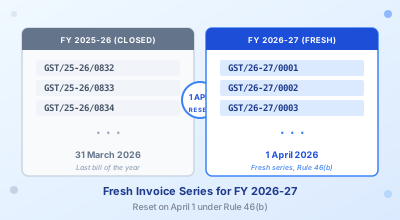
By mid-May every year, the same pattern shows up at small accounts teams. Someone uploads April GSTR-1 to the portal and three bills throw format errors. Two are over sixteen characters because finance added a vertical prefix in March and nobody recounted. One uses a hash mark in the number because the team migrated to a new template and the template did not know about the GSTIN format rules. The series itself was never reset on April 1; April invoices kept incrementing from where March left off, and that part the portal will accept silently and the audit officer will notice three years later.
Rule 46(b) of the CGST Rules covers all of this in two short clauses. Most posts about it parrot the rule and stop. This one walks through what to actually do for FY 2026-27: how to design a series that won't break GSTR-1, where the April reset slips through accounting setups, what to do about the credit-note carry in May, and what happens when a bill is already in the wild with a non-compliant number on it.
What Rule 46(b) Actually Requires
Rule 46(b) is part of Chapter VI of the CGST Rules, the chapter on tax invoice contents. The clause is short. Every tax invoice must carry a consecutive serial number that is:
- Not exceeding sixteen characters
- Composed only of alphabets, numerals, hyphen, and slash
- Unique within the financial year
That is the whole rule. The unique-within-FY part is what forces the April reset, in practice. If your March 2026 invoice was GST/0834 and your April 2026 invoice is GST/0835, you have unused numbers from 0001 to 0833 in FY 26-27. Wasteful, not technically illegal. The real failure surfaces at audit, when nobody can tell which GST/0500 came from which year without walking through the books year by year. The rule exists to make audits possible.
The consecutive requirement is interpreted as monotonically increasing within a series. Gaps are allowed (a voided draft, a cancelled bill) as long as the gap is documented. The portal does not validate consecutiveness on upload. A department officer doing a Section 65 audit will, though. They will ask why bill 0042 exists, then bill 0044, with nothing at 0043, and a "we cancelled it" answer needs the cancellation note backing it up.
Multiple parallel series are allowed and common. A business with three branches across Delhi, Karnataka, and Maharashtra will typically run a separate series per branch. Manufacturing and consulting verticals under the same GSTIN can also have their own series each, kept fully independent. Each individual series has to satisfy Rule 46(b) on its own (sixteen characters, allowed chars only, FY-unique within itself), and the labels need to be distinguishable enough that accounts can route bills without thinking too hard.
Designing a Series That Doesn't Break
What survives both audit and portal upload is a series with an FY marker baked into the format. GST/26-27/0001 is fourteen characters and signals at a glance which FY a bill belongs to. INV-2627-0001 is thirteen characters with the same effect. A bare 0001 is the design that fails: technically rule-compliant for the current year, but two years from now nobody can tell whether 0312 came from March 2026 or March 2027.
Pick a separator and stick to it. Hyphen and slash are both allowed; mixing them within a series (GST/26-27-0001 in March then GST-26/27/0001 in April) is the kind of inconsistency that audit officers note without saying anything. Slash is the more common convention in Indian accounting practice. Hyphen reads slightly cleaner. Either works.
Pad the sequence. 0001, not 1. A series that goes 1, 2, 99, 100, 101 looks fine in a list but sorts badly in Excel and reads inconsistently when reviewed in bulk. Four-digit padding handles most small-business volumes (up to 9999 invoices in a year, which is well past the GST registration threshold).
Working examples that all fit the sixteen-character ceiling:
GST/26-27/0001— fourteen characters, slash separator, FY visibleINV-26-27-0001— fourteen characters, hyphen separatorBNG/2627/0001— thirteen characters with a Bengaluru branch prefixMFG/26-27/0001— fourteen characters with a manufacturing-vertical prefix
Anti-examples that break:
INV#0001—#is not allowed; the portal rejects the uploadINVOICE-26-27-0001— eighteen characters; over the limit26/27/0001— ten characters and rule-compliant, but the FY reads ambiguously when separated from other context
The sixteen-character ceiling sounds generous. It is not, once finance starts asking for branch plus vertical plus FY plus sequence in one number. BNG/MFG/26-27/0001 is already seventeen. Either drop the branch from the number itself (track it in a separate field on the bill) or shorten the FY to 2627 to claw back two characters.
The Tally and Accounting-Software Trap
Most businesses are not typing invoice numbers into Excel any more. Tally, Zoho Books, Vyapar, and a handful of others handle invoice numbering through some kind of auto-increment counter. Each has a setting for FY-based numbering. Each also has a population of users who never enable that setting, because at the time the tool was set up the FY boundary was months away and resetting was not on anyone's mind.
The configuration in Tally lives under Voucher Class → Number Series → Restart numbering → Yearly. Enable it once, and the counter resets to whatever seed you configure on April 1. Skip it, and the counter keeps incrementing forever; your April 2026 bill ends up as GST/8341 because the count has been climbing uninterrupted since 2018. Zoho Books has a similar control under Invoice Settings, and Vyapar has the per-series Reset on Financial Year toggle. Whatever your tool is, the setting exists; the question is whether anyone has switched it on.
Finance teams who set up their accounting tool in mid-FY almost never circle back to enable the FY reset. By the time April comes around, the question of whether to reset has not been part of anyone's monthly checklist for six months, and the question only surfaces when GSTR-1 starts behaving strangely.
Industry texture worth noting. Small wholesale traders running 100 to 200 bills a month with self-managed invoicing forget the reset most often, and I see this most often at textile and jewellery wholesalers, where a single Excel sheet has been carrying the numbering since 2019 and the team treats it as a paperwork file rather than a compliance artefact. Their accounting cadence is monthly; the FY boundary does not register on their daily work. SaaS service businesses on hosted accounting tools are usually fine because the defaults are FY-aware out of the box. Restaurants, salons, and other consumer-facing service businesses sit somewhere in between, depending on whether their bookkeeping is in-house or outsourced.
The Credit-Note Carry
Credit notes against an old-FY invoice are where the reset confuses people. The rule itself is straightforward.
A credit note is a separate document with its own serial number, drawn from the credit-note series, not the invoice series. It carries a reference to the original invoice in field 5 of GSTR-1 (literally labelled "Original Invoice Number" on the form), and that field is where the old-FY invoice number sits. The credit-note number itself follows the credit-note series for the FY in which the credit note is issued.
Worked example. The original invoice is GST/25-26/0834, dated 18 March 2026. Customer reports a returned consignment in May 2026. You issue a credit note. The credit note gets the next number in your credit-note series for FY 26-27, which (if this is your first one of the new year) is CN/26-27/0001. The GSTR-1 entry for that credit note carries CN/26-27/0001 as its own number, references GST/25-26/0834 as the original invoice, and reverses the relevant tax against that invoice.
Two ways teams get this wrong. The first is giving the credit note the same number as the original invoice (GST/25-26/0834). That breaks because credit notes are their own document type with their own series. The second is putting the credit note in the old-FY series (CN/25-26/0001 issued in May 2026), which violates FY uniqueness for the old series and causes reconciliation problems at both ends.
If the original invoice itself was issued under a non-compliant number (over sixteen characters, disallowed character), the credit-note field 5 still references that exact non-compliant string. You do not retroactively clean up the old number. The cleanup happens through amendment, not through creative referencing in subsequent documents.
What Actually Breaks When the Series Breaks
Format errors at upload are the loudest failure. JSON upload to the portal validates length and allowed characters at the file level. A # in any single invoice number rejects the entire JSON. So does anything at character seventeen or beyond. The error messages do not always quote the offending character, only the row and column, and the fix usually requires re-exporting JSON from your accounting software after correcting the bill in your own system.
Re-issuing the invoice itself is not an option once the buyer has it. You amend in GSTR-1 instead. The original (non-compliant) number gets uploaded, then immediately amended in the same period or the next. The buyer sees an amendment in their GSTR-2B. Depending on how their reconciliation runs, they may chase you about the change or absorb it silently.
Duplicate numbers within an FY get accepted on first upload but cause downstream pain. The portal accepts both because the unique-within-FY rule is a compliance requirement, not a portal validation. The buyer sees two bills with the same number and asks which is which. Reconciliation slows down. If an audit officer sees the pattern and your books do not have a clean answer, it becomes a notice. The cost of the slip-up is paid in time and explanation, not in penalty rupees, but it adds up across audits.
Forgetting the FY reset entirely is the quiet failure mode. The portal accepts because each individual number is technically unique within FY 26-27, just starting at 0835 instead of 0001. The buyer's reconciliation runs fine. The compliance failure surfaces only at audit, two or three years later, when the officer asks why FY 26-27 invoice numbers do not start at 0001 like every other supplier they have ever audited. There is no good answer to that question. You are reduced to "we did not realise" and the officer notes it.
Starting Fresh in May
If you have been running invoices off a Word template or a self-managed Excel sheet, GSTExtract has a free invoice generator at gst-invoice-generator that handles seller and buyer details, line items, automatic CGST+SGST or IGST detection from state codes, and PDF download. Pick a clean series format (GST/26-27/0001 works) and start fresh from your next bill.
The format itself is on you for now: keep it inside the sixteen-character ceiling and stick to alphabets, numerals, hyphen, and slash. For anything past about fifty bills a month, dedicated accounting software starts paying for itself in time saved on reconciliation, GSTR-1 prep, and the FY reset itself. The generator is for the under-fifty-a-month layer where setting up a full accounting tool is more friction than it is worth.
Start a Compliant Invoice Series for FY 2026-27
Free generator with three templates, automatic tax split, and PDF download. No signup, no per-invoice charge.
Create InvoiceRelated Tools
- GST Invoice Generator — create a Rule-46-compliant invoice with a fresh FY 26-27 series, three templates, PDF download
- GST Invoice to Excel — pull invoice numbers and other fields out of vendor PDFs to verify your suppliers' series practices
- GSTIN Validator — structural check for the supplier GSTIN that will sit on the same bill
- 7 Common GST Invoice Errors — the broader catalogue of what goes wrong on bills, with invoice numbering as one chapter
- GSTR-2B Reconciliation in Excel — where supplier-side numbering errors surface at the buyer end three weeks later
- How to Read a GST Invoice — the field-by-field walkthrough, including invoice number conventions
- How to Find Company Details from a GST Number — the buyer-side lookup that runs on the GSTIN sitting on the same bill
- GSTR-9 for FY 2025-26 — the year-end annual return for the FY that just closed, where invoice series and rate-slab decisions made through the year get tallied into rate-wise tables
Generate a Compliant Invoice in Two Minutes
Three template styles, automatic CGST/SGST or IGST split from state codes, PDF download. Free to try.
Create InvoiceFrequently Asked Questions
Do I have to restart invoice numbering from 0001 on April 1?
Rule 46(b) does not name a starting number. What it requires is that each invoice number be unique within the financial year, and the settled interpretation is that you start a fresh series at FY beginning, typically from 0001. You can technically start from any number as long as it stays unique within FY 26-27, but every audit officer expects 0001. Continuing the old series into April (March was 0834, April is 0835) is not a portal violation but it is a compliance smell that surfaces at audit. The cheap and defensible practice is to reset to 0001 on April 1 every year.
What characters can I use in a GST invoice number?
Alphabets (A-Z, a-z), numerals (0-9), hyphen, and slash. That is the complete list. Hash, asterisk, underscore, ampersand, period, space, and any other punctuation are not allowed. The total length cannot exceed sixteen characters including separators. The portal validates these constraints at JSON upload, and a single invalid character rejects the entire month's filing until you correct the offending bill in your accounting software and re-export.
Can I have different invoice series for different branches or verticals?
Yes, and it is a common pattern. A business with three branches can run three series like BNG/26-27/0001, DEL/26-27/0001, MUM/26-27/0001, each numbered independently. Same applies to verticals such as MFG/26-27/0001 for manufacturing and SVC/26-27/0001 for services. The constraint is that each series individually satisfies Rule 46(b): sixteen characters, allowed chars only, and FY-unique within itself. The labels need to be distinguishable enough that your accounts team can route bills correctly without checking by hand.
What if I forgot to reset and have already filed two months with the old series?
Do not amend invoices already issued. The numbers on those bills are now binding documents and amending them retroactively creates bigger compliance trouble than the reset miss itself. The right fix is to start a fresh series from your next bill: pick a clean format like GST/26-27/0001, document that the change happened in your books, and continue from there. The audit explanation, when it comes, is that you discovered the lapse in May and corrected forward. That is a defensible answer. "We never reset because we did not know" is not.
Does the credit note follow the same series as the invoice?
No, and this is where teams slip. A credit note is a separate document type with its own serial number, drawn from the credit-note series, not the invoice series. The original invoice number lives in field 5 of GSTR-1 (literally "Original Invoice Number" on the form) as a reference. So a May 2026 credit note against a March 2026 invoice would be CN/26-27/0001 as its own number, with GST/25-26/0834 referenced as the original. Both are valid because they sit in different document-type series.