Blocked ITC Under Section 17(5)
The GST you paid on a purchase does not always come back to you. A fixed list of expenses is barred from credit, no matter how business-related they are.
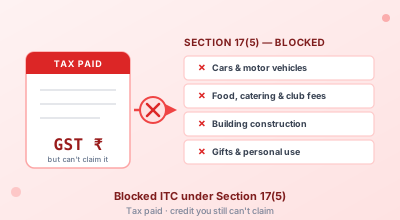
Most GST purchases give you the tax back. You pay GST to a supplier, and that same amount lands in your electronic credit ledger as input tax credit, ready to offset the GST you owe on your sales. It is the mechanism that stops tax from stacking on tax. But there is a hard exception, and it catches businesses every month: a list of purchases where you pay the GST and the law simply refuses to give it back. That list is Section 17(5) of the CGST Act — the blocked credit provision.
What makes Section 17(5) trip people up is that it does not care whether the expense is genuinely for business. A car used entirely for company work, a client lunch, tea for the staff, tiling the office floor — all real business spends, all blocked. The section is a flat negative list: if the purchase falls into a listed box, the credit is gone, and no amount of business justification reopens it. This post walks the whole list, the exceptions that do reopen a few of them, and what to do if you have already claimed something you shouldn't have.
What "Blocked Credit" Actually Means
Input tax credit normally works on one condition: you bought something taxable, used it for business, and you have a valid tax invoice for it. Section 17(5) sits on top of that as an override. It opens with a non-obstante clause — "notwithstanding anything" in the sections that grant credit — which is legal language for "ignore the usual rule; for these items, credit is denied." So even a purchase that passes every normal test for credit is denied if it lands in this list.
The practical consequence: the GST on a blocked purchase becomes a real cost to your business, not a recoverable one. It sits inside the price you paid and never comes back. That is why the list matters at the point of purchase decisions, not just at return time — the blocked GST is part of the true cost of that car, that office fit-out, that annual client dinner.
The Blocked List, Clause by Clause
Here is the whole of Section 17(5) in plain terms. The clause letters are the ones in the Act, so you can quote them to your accountant.
| Clause | What's blocked | When it's still claimable |
|---|---|---|
| (a), (aa) | Motor vehicles for passenger transport (seating ≤13, driver included), plus vessels and aircraft | You deal in them, run passenger transport, or run a driving/flying school |
| (ab) | Insurance, servicing, repairs on those same vehicles | Only where the vehicle itself is eligible above |
| (b) | Food & beverages, outdoor catering, health/beauty services, cosmetic surgery, club & gym membership, life & health insurance, employee travel benefits (rent-a-cab, LTA) | Onward supply of the same category; or where a law obliges the employer to provide it |
| (c), (d) | Works contract & goods/services for constructing an immovable property on your own account (incl. capitalised renovation) | Plant & machinery; or a builder claiming against an onward construction supply |
| (e) | Any inward supply of a person paying tax under the composition scheme | — (composition dealers get no ITC at all) |
| (f) | Inward supplies of a non-resident taxable person | IGST paid on their own imported goods |
| (g) | Goods or services used for personal consumption | Business portion, apportioned |
| (h) | Goods lost, stolen, destroyed, written off, or given as gifts / free samples | — |
| (i) | Tax paid on account of fraud, confiscation, detention (Sec 74, 129, 130 situations) | — |
The Four That Catch Ordinary Businesses
Most of the list is intuitive once you see it, but four clauses account for nearly every real dispute.
The car (clause a). This is the big one. A ₹12 lakh car carries roughly ₹2–3 lakh of GST, and for a normal business none of it is recoverable. The bar is tied to seating capacity: a vehicle approved to seat 13 or fewer including the driver is blocked. Buy a larger passenger vehicle, or a goods vehicle, and the credit comes back. The block also drags in the insurance, the servicing, and the repairs on that car — clause (ab) — so the running costs are blocked too. The only real escapes are being a car dealer, a cab operator, or a driving school.
Food and hospitality (clause b). Tea and snacks for staff, a team lunch, the year-end client dinner, catering at an event you host — all blocked. So are gym and club memberships you pay for, and the health-insurance premium for employees. The one exception people miss: if a labour law obliges you to provide something (canteen food above a headcount threshold, for instance), that specific mandated supply becomes claimable. And a restaurant or caterer buying food to resell as its own taxable supply is claiming against clause (b)'s "onward supply" opening, not breaching it.
Building construction (clauses c & d). Fitting out your own office, tiling a godown, adding a floor — the GST on that material and labour is blocked when the result is immovable property built on your own account. This one has caught large disputes; the crucial carve-out is plant and machinery, whose construction credit stays alive. A factory installing a production line claims it; the same factory building an office block next door does not.
Gifts and write-offs (clause h). Diwali gifts to clients, free samples, promotional giveaways, and stock that is lost, stolen, or written off — the input credit on all of it must be reversed. A common trap: a business claims credit on goods when purchased, then gives some away as gifts or scraps damaged stock later, and forgets to reverse the credit that clause (h) now blocks.
Sorting Claimable Credit From Blocked
Before you can flag what's blocked, you need every purchase invoice's GSTIN, value, and CGST/SGST/IGST split in one place. Drop a folder of purchase PDFs in and get a single Excel sheet you can tag, line by line.
Convert Invoices to ExcelHow the Exceptions Actually Work
The exceptions are narrower than they first read. There are really only three shapes to them, and it is worth knowing which shape applies before you assume a credit is safe.
Reselling or same-line supply. Almost every blocked category reopens if the thing you bought is what you sell. A car dealer's cars, a caterer's food, a builder's construction inputs — the block lifts because the purchase feeds directly into a taxable outward supply of the same nature. The test is not "is it for business"; it is "is it your stock-in-trade or a direct input to the same kind of supply you make."
Statutory obligation. A few clause (b) items — canteen food, certain insurance and transport for employees — become claimable when a law in force requires the employer to provide them. "We offer it as a perk" does not qualify; "the Factories Act compels us to run a canteen" can. The obligation has to come from a statute, not company policy.
Plant and machinery. The construction bar has one large door: credit on plant and machinery is preserved even when it is affixed to the earth, provided it meets the Act's definition (and excludes land, buildings, and civil structures). This is the line factories and infrastructure businesses argue over most, because the difference between "building" and "apparatus" can be tens of lakhs of credit.
If You Already Claimed It: Reversing in GSTR-3B
Blocked credit that slips into your books does not stay quietly wrong. Under the current regime the portal cross-checks aggressively — a mismatch between what you claimed and what your suppliers and the system expect increasingly triggers an automated DRC-01C intimation, and unresolved discrepancies can hold up your GSTR-3B filing itself. Catching your own error first is always cheaper.
The fix is a reversal. When you find that you claimed credit Section 17(5) blocks, report the amount in Table 4(B) of GSTR-3B — the "ITC reversed" block — for the period you catch it. That subtracts the wrong credit back out of your electronic credit ledger. If you catch it in the same month you claimed it, that is the whole story and it costs nothing extra. If the wrong credit had already been used to pay tax in an earlier month, interest under Section 50 runs on the amount from the date it was utilised until you reverse it, so the delay has a price. Either way, a self-reversal is far less painful than a departmental notice with penalty attached.
This is also why getting the CGST/SGST/IGST split and the expense category right off each purchase bill matters at booking, the same discipline that carries into GSTR-2B reconciliation. A blocked expense mis-tagged as claimable inflates your credit, and the set-off that follows spends credit you were never entitled to.
Where Blocked Credit Meets the Set-Off
Blocked credit and the GST set-off order are two halves of the same monthly exercise. Section 17(5) decides which credit is even allowed into your ledger; the set-off rules decide the order in which that allowed credit is spent against your liability. Get the first wrong and the second is built on sand — you will set off credit you should never have had, and a later reversal claws it back with interest.
So the sequence for a clean return is: strip out anything Section 17(5) blocks before the credit ever enters your GSTR-3B, then apply the set-off order to what remains. The two together are the whole of the input-tax-credit story for a normal business — what you may claim, and how you may spend it.
What to Take Away
Section 17(5) is a flat list of purchases where GST credit is denied regardless of business use: passenger cars and their running costs, food and hospitality, club and gym fees, employee benefits unless a law compels them, building construction other than plant and machinery, personal-use goods, gifts and write-offs, and tax paid on fraud. The exceptions are narrow — reselling, same-line onward supply, statutory obligation, and plant and machinery. If you have claimed something blocked, reverse it in Table 4(B) of GSTR-3B before the portal flags it, and remember interest runs on any credit already used. Treat the blocked GST as a real cost of the purchase, decide claimable versus blocked at booking, and the rest of the return follows cleanly.
Related Tools
- GST Set-Off Calculator — once you know which credit is claimable, work out net cash payable and carried-forward credit in the correct legal order
- GST Invoice Reader — pull GSTIN, value, and the CGST/SGST/IGST split off a folder of purchase PDFs into one Excel sheet
- GST Calculator — add or remove GST with the CGST/SGST/IGST split
- GSTIN Details Lookup — for 1 lookup credit, confirm a vendor is active before you rely on the credit at all
- The GST Set-Off Order — why you pay cash while holding unused ITC, and the one lever you control
- GSTR-2B Reconciliation in Excel — matching claimed credit to what your suppliers actually reported
- Accept, Reject or Pending in IMS — the button press that decides whether a supplier's invoice reaches your 2B at all
- The GST Composition Scheme — why a composition supplier's bill carries no credit for you at all, and when the scheme makes sense for them
Building Your GSTR-3B From a Folder of Invoices?
Drop your purchase and sales PDFs in and get one Excel sheet with GSTIN, invoice value, and the CGST/SGST/IGST split already in their own columns. Tag the blocked lines, total your eligible credit, then run the set-off. Free to try, no signup.
Convert to ExcelFrequently Asked Questions
What is blocked credit under Section 17(5) of GST?
Blocked credit is input tax credit the law refuses to let you claim even though you paid GST and use the purchase for business. Section 17(5) of the CGST Act lists the categories: passenger motor vehicles, food and catering, club and gym membership, life and health insurance and employee travel, works-contract and building construction, gifts and free samples, goods lost or written off, personal-use goods, and tax paid under fraud provisions. If a purchase is on the list, the credit is barred regardless of business use.
Can I claim ITC on a car bought for my business?
Usually no. ITC on a motor vehicle for passenger transport with an approved seating capacity of 13 or fewer (driver included) is blocked under Section 17(5)(a), along with its insurance, servicing and repairs. Business use does not unblock it. Credit is allowed only if you deal in such vehicles, run passenger transport, or run a driving school. Goods-transport vehicles like trucks and vans are not covered and their credit is allowed.
Is GST on staff food, tea, or a team lunch claimable?
No, as a general rule. ITC on food and beverages and outdoor catering is blocked under Section 17(5)(b), even for staff or clients. Two openings exist: credit is allowed where the supply feeds an outward taxable supply of the same category (a restaurant buying catering), and where a law in force obliges the employer to provide it. Ordinary staff refreshments and client meals stay blocked.
How do I reverse ITC that turns out to be blocked?
Reverse it in the GSTR-3B for the period you catch it, by reporting the amount in Table 4(B) (ITC reversed). That nets the wrong credit back out of your electronic credit ledger. Catching it the same month costs nothing extra; catching it later means interest under Section 50 runs on the amount from the date it was wrongly used. A voluntary reversal is far cheaper than waiting for a DRC-01C mismatch notice.
Is ITC on building construction and repairs blocked?
Yes, largely. Section 17(5)(c) and (d) block ITC on goods and services used to construct an immovable property on your own account — materials, labour, and capitalised renovation of a building. The main exception is plant and machinery, whose construction credit stays eligible, and a builder claiming against an onward taxable construction supply. A business fitting out its own office generally cannot claim that GST.