The GST Composition Scheme
1% of turnover instead of 18% on value added sounds like an easy win. It isn't automatic — you cannot charge that 1% to your customer, and it stops paying below a certain margin.
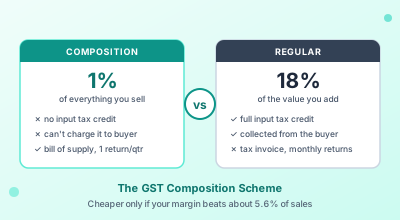
The composition scheme is the one part of GST that was written for the small shop. Instead of charging tax on every sale, tracking credit on every purchase, and filing monthly returns, you pay a flat percentage of your turnover, file one statement a quarter, and get on with the business. Section 10 of the CGST Act sets it up; a turnover of ₹1.5 crore in the previous year gets you in.
What almost every explainer skips is the part that decides whether you should take it. Composition tax is not a lower version of GST — it is a different kind of cost. Regular GST is collected from your customer and passes through you; composition tax is paid by you, out of the price you already charged. That single difference is what makes the scheme brilliant for some businesses and quietly expensive for others, and there is a number that tells you which one you are.
What You Are Actually Signing Up For
Opting in is a trade. You give up three things and get three things back.
You give up: input tax credit on every purchase (the GST your suppliers charge becomes a straight cost), the right to charge tax on your sales, and the right to sell outside your own state. You get: a flat low rate on turnover, one quarterly payment instead of monthly returns, and no invoice-level reporting of your sales at all.
That last point has a shape worth noticing. A composition dealer files CMP-08 with a single turnover figure — not GSTR-1 with invoice details — so your sales never reach anyone's GSTR-2B or their Invoice Management System. You step outside the invoice-matching machinery entirely. For a shop selling to walk-in customers that is pure relief. For anyone selling to registered businesses it is a problem, and we will come to why.
Who Can Opt In
Eligibility runs on your aggregate turnover in the preceding financial year, computed PAN-wide across every GST registration you hold in India — including exempt supplies. If you have registrations in two states, both count toward the same ceiling, and both must opt in together or neither can.
| Who | Preceding-year turnover limit |
|---|---|
| Traders, manufacturers, restaurants — most states | ₹1.5 crore |
| Same, in the eight special category states* | ₹75 lakh |
| Service providers, under Section 10(2A) | ₹50 lakh |
*Arunachal Pradesh, Manipur, Meghalaya, Mizoram, Nagaland, Sikkim, Tripura and Uttarakhand (Notification 14/2019-Central Tax). Every other state and union territory is at ₹1.5 crore.
Note the ₹1.5 crore composition ceiling is a different number from the GST registration threshold of ₹40 lakh for goods and ₹20 lakh for services. Registration is about whether you must be in GST at all; composition is about how you pay once you are in.
The Four Rates — and the Bases They Apply To
The rates are widely quoted; the base each one applies to is not, and it is where money changes hands.
| Category | Rate | Applied to |
|---|---|---|
| Manufacturers (other than notified goods) | 1% | Turnover in the state — including exempt supplies |
| Traders and other suppliers of goods | 1% | Turnover of taxable supplies only |
| Restaurant service (no alcohol) | 5% | Turnover in the state |
| Service providers under Section 10(2A) | 6% | Turnover in the state |
The trader-versus-manufacturer split is the one people get wrong. A trader dealing partly in exempt goods — unbranded foodgrain, fresh produce — pays 1% only on the taxable half. A manufacturer pays 1% on the whole state turnover, exempt output included. Same rate, materially different bill.
Two more details attach to the goods scheme. A dealer in goods may also supply services up to the higher of 10% of the preceding year's state turnover or ₹5 lakh, without losing the option — that carve-out is what lets a shop take installation or delivery charges. And the September 2025 rate rationalisation, which reshuffled the main GST slabs, left Section 10 and Rule 7 untouched: composition rates and thresholds are unchanged.
The Part That Decides It: You Cannot Collect the Tax
Section 10(4) is blunt — a composition taxpayer shall not collect any tax from the recipient. You issue a bill of supply, not a tax invoice, with the declaration "composition taxable person, not eligible to collect tax on supplies" printed on it, and the same words displayed on your signboard.
So the 1% is not a tax you add to the price. It is a slice of the price you already charged. Compare that with regular GST, where the 18% on your sale is collected from the customer and the 18% on your purchases comes back as credit — the only GST you genuinely bear is the tax on the value you added. Set the two side by side and the comparison becomes arithmetic:
- Composition cost = your rate × everything you sell.
- Regular GST cost = the GST rate × the value you add.
Turnover is a big number. Value added is a small one. Which cost is lower depends entirely on how big your margin is relative to your sales.
Two Traders, Same Turnover, Opposite Answers
Both sell 18% goods to walk-in consumers who pay ₹94,40,000 across the year. Neither can raise the shelf price — the market sets it. The only difference is what they buy at.
| Trader A — 8.5% margin | Trader B — 2.1% margin | |
|---|---|---|
| Collected from customers | ₹94,40,000 | ₹94,40,000 |
| Purchases (excl. GST) | ₹72,00,000 | ₹78,00,000 |
| GST paid to suppliers | ₹12,96,000 | ₹14,04,000 |
| Under regular GST | Output ₹14,40,000 − credit ₹12,96,000 = ₹1,44,000 cash | Output ₹14,40,000 − credit ₹14,04,000 = ₹36,000 cash |
| Profit, regular | ₹8,00,000 | ₹2,00,000 |
| Under composition | 1% of ₹94,40,000 = ₹94,400, no credit | 1% of ₹94,40,000 = ₹94,400, no credit |
| Profit, composition | ₹8,49,600 | ₹1,41,600 |
| Better off | Composition, by ₹49,600 | Regular, by ₹58,400 |
Trader A pockets the difference. Trader B pays ₹94,400 of composition tax on ₹2,00,000 of gross margin and loses nearly a third of the year's profit to a scheme sold as the cheap option. Identical turnover, identical rate, opposite outcome — and the only variable is margin.
The Break-Even Margin
The crossover point falls out of the arithmetic. The two costs are equal when
your margin ÷ what customers pay you = composition rate ÷ GST rate
Which gives a table you can check yourself against in about ten seconds:
| GST rate on what you sell | Composition pays off above a margin of |
|---|---|
| 5% | ~20% of sales |
| 12% | ~8.3% of sales |
| 18% | ~5.6% of sales |
| 28% | ~3.6% of sales |
Two consequences worth sitting with. A thin-margin, high-volume trade in low-rate goods is the worst possible fit — a 5% grocery line needs a 20% margin before composition breaks even, and grocery does not run at 20%. And restaurants get almost nothing: a regular restaurant already pays 5% with no input credit, and it charges that 5% to the diner. Under composition the rate is the same 5% but it comes out of your own bill total. What you are buying there is paperwork relief, not a lower tax.
Working Out Your Own Numbers
The margin test needs one year of purchase totals with the tax split out. Drop a folder of supplier invoices in and get GSTIN, invoice value and the CGST/SGST/IGST columns in one Excel sheet you can total.
Convert Invoices to ExcelThe B2B Problem
Everything above assumes you sell to consumers. Sell to registered businesses and a second cost lands, one that never shows up in your own books.
Your buyer gets no credit. Section 17(5)(e) blocks input tax credit on any inward supply from a composition taxpayer, and there is no tax on a bill of supply to claim in the first place. So a business buying ₹1,00,000 of goods from you is paying ₹1,00,000 of real cost, where the same purchase from a regular supplier would have cost it ₹84,746 after recovering the credit. You have not saved that buyer anything — you have made yourself roughly 18% more expensive than a competitor quoting the identical price.
Buyers work this out. Either they push your price down by what they lose, or they move to a registered supplier at renewal. The composition scheme is a B2C instrument; if a meaningful share of your revenue is invoices to companies, the credit break in the chain will cost you more than the rate ever saves.
The Small Print That Disqualifies People
Beyond turnover, a list of hard bars applies. Any one of them and the option is off:
- No inter-state outward supply. You may buy from anywhere; you may only sell within your own state. That also rules out exports, which count as inter-state supply.
- No services through an e-commerce operator that collects TCS under Section 52. Goods through an operator became permissible from 1 October 2023 after the Finance Act 2023 amendment, but only for intra-state supply — services remain barred.
- No supply of non-taxable goods, which in practice means alcoholic liquor for human consumption.
- No manufacture of notified goods — ice cream and edible ice, pan masala, tobacco products, aerated water, and fly-ash or building bricks.
- Not available to casual taxable persons or non-resident taxable persons.
- All registrations under one PAN must opt in together.
One more that catches people after the fact: reverse charge liability is paid at normal rates, not composition rates, and no credit is available on it. Rent a commercial property from an unregistered landlord, take a goods-transport service, import a service — you pay the full 18% under RCM and it is a dead cost.
The Compliance Calendar
The paperwork relief is real, and it is the strongest argument for the scheme when the margin test is close.
| Form | What it does | When |
|---|---|---|
| CMP-02 | Opt in for the coming financial year (existing registrations) | Before that financial year starts |
| ITC-03 | Reverse the credit sitting in stock on the day you enter | Within 60 days of the year starting |
| CMP-08 | Quarterly statement-cum-challan — turnover and tax paid | 18th of the month after each quarter |
| GSTR-4 | Annual return | 30 June following the financial year |
| CMP-04 | Notice of withdrawal, voluntary or on crossing the limit | Within 7 days of the trigger |
| ITC-01 | Claim credit on stock held when you exit | Within 30 days of withdrawal |
That GSTR-4 date moved: Notification 12/2024-Central Tax shifted it from 30 April to 30 June, applicable from FY 2024-25 onward. Late CMP-08 runs ₹200 a day capped at ₹5,000; late GSTR-4 runs ₹50 a day capped at ₹2,000, or ₹500 for a nil return, and interest on unpaid tax is 18% a year. All four quarterly CMP-08s must be filed before the portal will accept the annual GSTR-4. Our GST return due-date page keeps the current quarter's dates in one place.
Crossing the Limit Mid-Year
The option does not run to the end of the year politely. It lapses on the day your turnover crosses ₹1.5 crore (or ₹50 lakh on the services scheme). From that day you are a regular taxpayer: you charge tax on invoices, you file CMP-04 within seven days, and you file ITC-01 within thirty days to claim credit on the inputs, semi-finished and finished goods in stock at the switch — with capital goods reduced pro rata for the time already used.
The practical failure is not the paperwork, it is the invoices issued in the gap. Sales made after the crossing but billed on a bill of supply carry tax you never collected and now owe from your own pocket. If your turnover is anywhere near the ceiling by the third quarter, track it weekly.
So Who Should Actually Take It
Composition is a clean fit when four things are true at once: you sell to consumers, within one state, at a margin above the break-even for your rate, and you value not running monthly returns. A neighbourhood retailer, a local manufacturer selling through its own counter, a small workshop — this is the scheme working as intended.
It is the wrong instrument when you invoice businesses, when you sell across state lines or online outside your state, when your margin is thin against a low GST rate, or when you are growing fast enough to cross ₹1.5 crore mid-year. In those cases the flat rate looks cheap and the lost credit — yours and your buyer's — quietly costs more.
What to Take Away
The composition scheme charges 1% of turnover for goods, 5% for restaurants and 6% for services, against limits of ₹1.5 crore, ₹75 lakh in eight states, and ₹50 lakh for services. The rate is not the point. Because Section 10(4) stops you charging the tax to the customer, composition is a levy on sales where regular GST is a levy on value added — so it only saves money above a margin of roughly the composition rate divided by your GST rate, about 5.6% of sales for 18% goods. Add the fact that business buyers lose their credit entirely, and the scheme resolves to a simple rule: excellent for a decent-margin shop selling to consumers in one state, expensive for almost everyone else.
Related Tools
- GST Registration Limit Checker — whether you need to be registered at all, before you decide how to pay
- GST Return Due Dates — CMP-08, GSTR-4 and the rest of the calendar in one place
- GST Calculator — add or remove GST and see the CGST/SGST/IGST split
- GST Invoice Reader — pull a year of purchase invoices into one Excel sheet to run the margin test
- GSTIN Details Lookup — for 1 lookup credit, check whether a supplier is registered as a composition taxpayer before you count on the credit
- Blocked ITC Under Section 17(5) — clause (e) is the one that blocks credit on a composition dealer's supply
- The GST Set-Off Order — how credit is actually spent once you are a regular taxpayer
Comparing Composition Against Regular GST?
The decision needs one clean number: the tax you actually paid on purchases last year. Drop your supplier PDFs in and get GSTIN, invoice value and the CGST/SGST/IGST split in their own Excel columns. Free to try, no signup.
Convert to ExcelFrequently Asked Questions
What is the turnover limit for the GST composition scheme?
For suppliers of goods, manufacturers and restaurants the limit is aggregate turnover of ₹1.5 crore in the preceding financial year, reduced to ₹75 lakh in eight special category states — Arunachal Pradesh, Manipur, Meghalaya, Mizoram, Nagaland, Sikkim, Tripura and Uttarakhand. Service providers have a separate scheme under Section 10(2A) with a ₹50 lakh limit. Aggregate turnover is computed PAN-wide across all your GST registrations and includes exempt supplies.
Can a composition dealer charge GST to the customer?
No. Section 10(4) bars a composition taxpayer from collecting tax from the recipient. You issue a bill of supply, not a tax invoice, carrying the declaration that you are a composition taxable person not eligible to collect tax on supplies. The 1%, 5% or 6% is paid out of the price you already charged — it comes from your own margin instead of being passed on.
Is the composition scheme actually cheaper than regular GST?
Only above a certain margin. Under regular GST you really bear tax only on the value you add, because output tax is collected from the customer and input tax comes back as credit. Under composition you pay a flat percentage of everything you sell with no credit. The two are equal when your margin, as a share of what customers pay you, equals the composition rate divided by your GST rate — roughly 5.6% for 18% goods, 8.3% at 12%, and 20% at 5%. Above that, composition wins; below it, regular GST costs less.
What returns does a composition dealer have to file?
Two. CMP-08 is a quarterly statement-cum-challan declaring turnover and paying the tax, due by the 18th of the month after each quarter. GSTR-4 is the annual return, due 30 June following the financial year since Notification 12/2024-Central Tax moved it from 30 April. Late CMP-08 costs ₹200 a day capped at ₹5,000; late GSTR-4 costs ₹50 a day capped at ₹2,000, or ₹500 for a nil return. Opting in for a coming year is done in CMP-02 before that year begins.
Can my buyer claim input tax credit on a composition dealer's bill?
No. Section 17(5)(e) blocks input tax credit on any inward supply from a composition taxpayer, and a bill of supply carries no tax component to claim. Your supplies also never appear in the buyer's GSTR-2B or IMS, because you file CMP-08 rather than GSTR-1. That is why the scheme rarely suits a business selling to other registered businesses — the buyer loses credit worth 5% to 18% of the price and will price that loss back into what they pay you.